Data may be outdated
Last updated: 9 months ago — Click refresh to get the latest statistics.
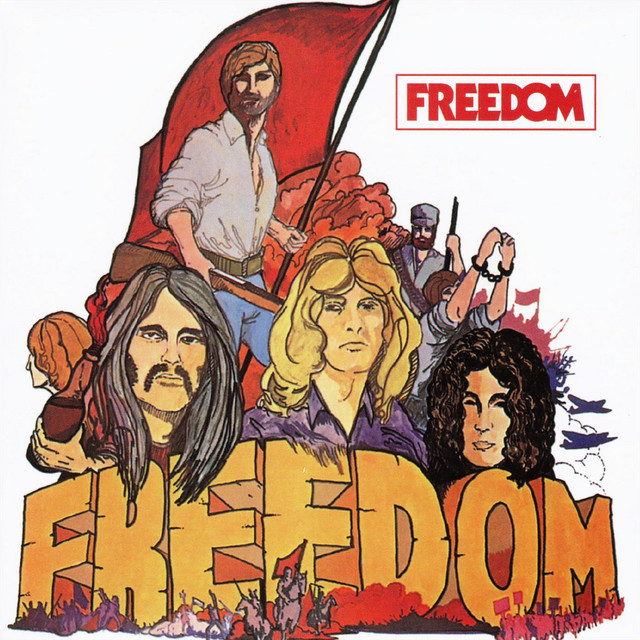
A spin-off of <a href="spotify:artist:0GbqW5TJr7n4is453VOY4C">Procol Harum</a>, Freedom was formed by guitarist Ray Royer and drummer <a href="spotify:artist:1NaHeFXyIQ5Erby1Nw3XjY">Bobby Harrison</a>. Both of them were in <a href="spotify:artist:0GbqW5TJr7n4is453VOY4C">Procol Harum's</a> lineup at the outset for their debut "A Whiter Shade of Pale" single, but were ousted almost immediately when <a href="spotify:artist:0GbqW5TJr7n4is453VOY4C">Procol</a> singer, <a href="spotify:artist:4ujjmWsaeth22P6EdnMCrR">Gary Brooker</a>, enlisted his former bandmates from the <a href="spotify:artist:79opYT6ed4vFUfREUfxuqP">Paramounts</a>, <a href="spotify:artist:0MAvx5yzdhylg2ztJC3MD3">Robin Trower</a> and Barry Wilson, as replacements. Freedom's early sound, perhaps unsurprisingly, echoed <a href="spotify:artist:0GbqW5TJr7n4is453VOY4C">Procol Harum's</a> in its prominent use of organ and piano, as well as heavy rock guitar, and like <a href="spotify:artist:0GbqW5TJr7n4is453VOY4C">Procol Harum's</a> early records, captured late British psychedelia as it was starting to inch toward progressive rock.
Freedom wasn't a <a href="spotify:artist:0GbqW5TJr7n4is453VOY4C">Procol Harum</a> clone, though, with a somewhat poppier take on psychedelia that was closer to <a href="spotify:artist:1CD77o9fbdyQFrHnUPUEsF">Traffic</a> than <a href="spotify:artist:0GbqW5TJr7n4is453VOY4C">Procol Harum</a>. Their initial lineup only released two singles in 1968 before breaking up, also recording a soundtrack for an obscure Italian film by Dino De Laurentis, Attraction/Black on White. The soundtrack LP was given a limited release in Italy -- so limited, in fact, that the group members themselves were unaware that it had come out. Recorded with noted future producers Eddie Kramer and Glyn Johns engineering, this was reissued on CD in 1999, and is actually a pretty good if derivative slice of late-'60s British psychedelia.
In 1968, <a href="spotify:artist:1NaHeFXyIQ5Erby1Nw3XjY">Harrison</a> decided to reorganize the band completely -- in fact, so totally that he was the only remaining original member. More albums came out in the late '60s and early '70s which, in keeping with overall British rock trends of the period, were in a much heavier, hard, bluesier style. These were middle-of-the-pack, or a little lower than the middle-of-the-pack, efforts with nothing to make them stand out from the crowd in a clogged field. They did get to tour the U.S. as support for <a href="spotify:artist:5M52tdBnJaKSvOpJGz8mfZ">Black Sabbath</a> and <a href="spotify:artist:6w6z8m4WXX7Tub4Rb6Lu7R">Jethro Tull</a>, and broke up in 1972 after some personnel changes. <a href="spotify:artist:1NaHeFXyIQ5Erby1Nw3XjY">Harrison</a> became the lead singer in the little-known <a href="spotify:artist:4IjNLEdQccLGYrmMh6jLHa">Snafu</a>, while guitarist Roger Saunders, from the later incarnation of the band, did some session work, joined <a href="spotify:artist:2DDBSi3h22DDMvGCKG1r8T">Medicine Head</a>, and played in <a href="spotify:artist:61zv3hX7l838ZyhaDyAx8S">Gary Glitter's</a> group during the '80s. ~ Richie Unterberger, Rovi
Freedom wasn't a <a href="spotify:artist:0GbqW5TJr7n4is453VOY4C">Procol Harum</a> clone, though, with a somewhat poppier take on psychedelia that was closer to <a href="spotify:artist:1CD77o9fbdyQFrHnUPUEsF">Traffic</a> than <a href="spotify:artist:0GbqW5TJr7n4is453VOY4C">Procol Harum</a>. Their initial lineup only released two singles in 1968 before breaking up, also recording a soundtrack for an obscure Italian film by Dino De Laurentis, Attraction/Black on White. The soundtrack LP was given a limited release in Italy -- so limited, in fact, that the group members themselves were unaware that it had come out. Recorded with noted future producers Eddie Kramer and Glyn Johns engineering, this was reissued on CD in 1999, and is actually a pretty good if derivative slice of late-'60s British psychedelia.
In 1968, <a href="spotify:artist:1NaHeFXyIQ5Erby1Nw3XjY">Harrison</a> decided to reorganize the band completely -- in fact, so totally that he was the only remaining original member. More albums came out in the late '60s and early '70s which, in keeping with overall British rock trends of the period, were in a much heavier, hard, bluesier style. These were middle-of-the-pack, or a little lower than the middle-of-the-pack, efforts with nothing to make them stand out from the crowd in a clogged field. They did get to tour the U.S. as support for <a href="spotify:artist:5M52tdBnJaKSvOpJGz8mfZ">Black Sabbath</a> and <a href="spotify:artist:6w6z8m4WXX7Tub4Rb6Lu7R">Jethro Tull</a>, and broke up in 1972 after some personnel changes. <a href="spotify:artist:1NaHeFXyIQ5Erby1Nw3XjY">Harrison</a> became the lead singer in the little-known <a href="spotify:artist:4IjNLEdQccLGYrmMh6jLHa">Snafu</a>, while guitarist Roger Saunders, from the later incarnation of the band, did some session work, joined <a href="spotify:artist:2DDBSi3h22DDMvGCKG1r8T">Medicine Head</a>, and played in <a href="spotify:artist:61zv3hX7l838ZyhaDyAx8S">Gary Glitter's</a> group during the '80s. ~ Richie Unterberger, Rovi
Monthly Listeners
2,438
Monthly Listeners History
Track the evolution of monthly listeners over the last 28 days.
Followers
2,765
Followers History
Track the evolution of followers over the last 28 days.
Top Cities
49 listeners

38 listeners
31 listeners
29 listeners
23 listeners
Related Artists




Odyssey
Damnation
Tucky Buzzard

Elias Hulk

Tin House
Toe Fat

Hard Meat

Tear Gas


After Shave

Stonewall
Incredible Hog


Dog Soldier

Ramatam