Data may be outdated
Last updated: 1 week ago — Click refresh to get the latest statistics.
Eisler's family could not afford a piano, so he learned music from books and scores, an activity he continued through his teen years (1908 - 1915) at the Staatsgymnasium. In World War I, he served in a Hungarian regiment (1916 - 1918), composed an oratorio Gegen den Krieg (Against War, a title revived later for his cantata with words by Brecht), and afterwards became a student at the New Vienna Conservatory and a proofreader for Universal Edition.
Both <a href="spotify:artist:5U827e4jbYz6EjtN0fIDt9">Arnold Schoenberg</a> and <a href="spotify:artist:6cg7ooZDeSSLYVTWGpASjX">Anton Webern</a> gave Eisler free private lessons in composition (1919 - 1923), influencing Eisler's highly chromatic and harmonically dense yet witty and graceful early style (notably in the Piano Sonata, Op. 1). Eisler moved to Berlin to teach in 1925, and thinned his harmonic style and added jazz-inspired rhythms. The next year, Eisler joined the German Communist Party, wrote articles for the periodical Rote Fahne (Red Flag), and composed choral works (eg., "Der neue Stern"/The New Star) and popular marching songs ("Solidaritätslied"/Solidarity Song, "Einheitsfrontlied"/The United Front Song, and other classics).
In 1930 he began his lifelong collaboration with writer <a href="spotify:artist:0uZEznXmvyfBOsANICyyxT">Berthold Brecht</a>, immediately producing Die Massnahme and one of the first important works of socialist realism, the moving cantata Die Mutter (The Mother, 1932). This work contains neo-Classical elements, energetic choruses ("Der zerrissene Rock"/The Torn Coat, about factory bosses who deride workers' needs, and the "Grabrede"/Funeral Oration, a melodically powerful Stravinskian harmonization of Gregorian chant), and touching arias (the extraordinarily beautiful quasi-twelve-tone song "Lob der dritten Sache"/In Praise of Lower Class Causes). The final chorus contains the image of the Mother carrying the red banner, untiringly.
After 1933, Eisler's works were banned by the Nazis. Forced into exile for 15 years, he traveled throughout Europe and to the U.S. and Mexico, teaching and composing for films (such as the beautiful Fourteen Ways of Describing the Rain, 1941, based on an anagram of the name <a href="spotify:artist:5U827e4jbYz6EjtN0fIDt9">Schoenberg</a>). Eisler began his largest work in 1935, the Deutsche Sinfonie, Op. 50 (1935 - 1957), a soul-moving, dramatic, "anti-fascist cantata" in Eisler's tonal-serialist style. The text is by Brecht with portions from the novel Bread and Wine (1936) by the "renegade" author Ignazio Silone, who opposed Stalin's "show trials."
In 1947, Eisler and Brecht were brought before the infamous House Committee on Un-American Activities and questioned about works like "Lob des Kommunismus" (In Praise of Communism) from Die Mutter which states that communism is against filth and criminality. Eisler left the States and eventually settled in the DDR, composing their national anthem, and writing "applied music" for the theater (17 plays), cinema, cabaret (36 chansons, and the splendid "Neue deutsche Volkslieder"/ New German Folksongs), television, public events, and so on.
Monthly Listeners
28,359
Monthly Listeners History
Track the evolution of monthly listeners over the last 28 days.
Followers
6,256
Followers History
Track the evolution of followers over the last 28 days.
Total Streams
9.7 million
Total Streams History
Track the evolution of total streams over the last 28 days. This data is calculated from all tracks listed in the artist's discography.
Top Cities

Related Artists

Oktoberklub
Großer Chor Des Berliner Rundfunks
Großes Rundfunkorchester Leipzig
Sabine, Jörn und Lutz vom Oktoberklub Berlin
Chor und Musikkorps des Wachregiments "Feliks Dzierzynski" Berlin
Hermann Hahnel


Alexandrov Red Army Choir

Angelika Sacher & Klaus Bergmaier

Paul Dessau
Ensemble "Klassenbrüder - Waffenbrüder" Karl-Marx-Stadt


Dr. Ludwig

Wolfgang Neuss
Kurt Demmler

Musica Silesia


Vocal Heroes
Free Willy

IFA Wartburg


Jugendchor und Orchester der Arbeiterfestspiele der DDR
Bernd Walther

Des Geyers schwarzer Haufen
Ernst Busch

Orchester der Arbeiterfestspiele
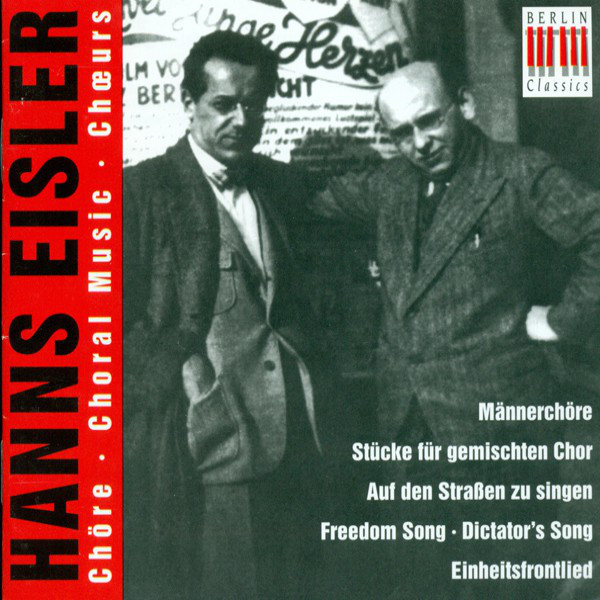
Rundfunkchor- und Sinfonieorchester Leipzig
Arbeiterchor Aus Berliner Betrieben
Eisenbahnpionierchor Berlin des Gewerkschaftsensembles "Ernst Moritz Arndt"
Musikkorps des Wachregiments Berlin