Data may be outdated
Last updated: 2 months ago — Click refresh to get the latest statistics.
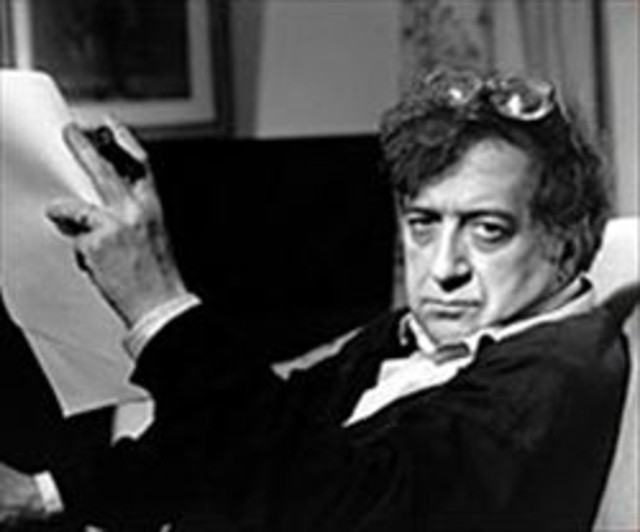
Berio was born on October 24, 1925, in Oneglia, Italy. His father, Ernesto, and grandfather, Adolfo, both organists, taught the young Luciano piano and composition. Berio was drafted into the army, but eventually joined partisans against the Nazis. A serious hand wound precluded further study on piano. Following the war, although his initial intention was to study law, he moved to Milan where he studied composition at the conservatory with Giulio Cesare Paribeni and <a href="spotify:artist:5LitxxThqiHS2F0lQncuHL">Giorgio Ghedini</a>. <a href="spotify:artist:5LitxxThqiHS2F0lQncuHL">Ghedini</a>, known for his interest in many styles, passed that interest on to Berio. While in school, the aspiring composer met and married mezzo-soprano <a href="spotify:artist:16DbD9W1Z3yEONK5oW4pL6">Cathy Berberian</a>, a vocalist known for her remarkable versatility. In 1952 Berio traveled to the U.S. to study under the influential composer <a href="spotify:artist:55ey4I8qx9nDDuGg17sbAC">Luigi Dallapiccola</a> at Tanglewood. <a href="spotify:artist:55ey4I8qx9nDDuGg17sbAC">Dallapicolla</a> introduced him to 12-tone composition, and Berio's compositional development began taking new turns shortly afterward. He took an interest in working with sound as a musical parameter and met the electronic music pioneers <a href="spotify:artist:7IGFUlUZeXQrb9xcEAInD4">Ussachevsky</a> and <a href="spotify:artist:27YluXpxOS5Bsvl2yb5iRZ">Luening</a>. This led him, on his return to Europe, to seek out <a href="spotify:artist:074KQsY66BZlVAn9zrvxH2">Bruno Maderna</a>, <a href="spotify:artist:6HhWosNZXCKGssXoZRiz3P">Henri Pousseur</a>, and <a href="spotify:artist:5PkKmEWhfJ9jHVHXbZl0Ks">Karlheinz Stockhausen</a>, leaders of the European avant-garde who were also interested in electronic music. He attended summer sessions in Darmstadt between 1956 and 1969, but before that he founded the Studio di Fonoglia at the Italian radio headquarters, in collaboration with <a href="spotify:artist:074KQsY66BZlVAn9zrvxH2">Maderna</a>. It emerged as one of the top electronic music centers in Europe and introduced him to <a href="spotify:artist:1Z3fF5lZdCM0ZHugkGoH8s">John Cage</a>. Berio also published an electronic music journal called Incontri Musicali and began pursuing a means of reconciling electronic music with musique concrète. In 1958 Berio completed his breakthrough Thema (Omaggio a Joyce), which manipulated a sound source of a reading from Ulysses; Allez-Hop, inspired by an Italo Calvino text, followed a year later. In 1961 he abandoned his directorship of the Studio, and two years later moved to the U.S., assuming a teaching post at Mills College. Over the next decade he would also teach at Harvard, Juilliard, and other well-known American institutions. During this period Berio became increasingly fascinated by rock and folk music, incorporating elements of both into his own work. Indeed, Berio's major works of the era -- Visage, Passaggio, Laborintus II, and the Sequenza series (begun in 1958) among them -- seem to draw upon virtually every major Western musical tradition, with an increasing emphasis on electronic media and tape. The Sequenza series, each of which explored the timbral possibilities of a particular instrument, is perhaps his best-known work, and Sequenza III (1965) the most representative of Berio's vocal writing. It was one of several pieces -- such as Chamber Music (1953), Circles (1960), and Folk Songs (1964) -- composed for <a href="spotify:artist:16DbD9W1Z3yEONK5oW4pL6">Berberian</a>. Berio continued to write for her even after their divorce in 1964. Another remarkable "American" composition was Sinfonia (1969), a striking work built on the principles of quotation and collage. It helped solidify his reputation as one of the most versatile among progressive voices on the contemporary scene. The composer left his Juilliard post in 1971 and returned to Italy the following year. From 1974 to 1980, Berio headed the electro-acoustic section of the Paris-based IRCAM, the organization founded by <a href="spotify:artist:2prZJWfQMnIgwUKxKcBxH7">Pierre Boulez</a>. In the period between 1979 and 1984, Berio composed Un re in ascolto (A King Listens), "a musical action," the composer explained, and not truly an opera, based on a story by Calvino. Berio's important later works include Rendering (1990), which utilizes the sketches of <a href="spotify:artist:2p0UyoPfYfI76PCStuXfOP">Schubert</a>'s Tenth Symphony, the ballet Compass (1995), and the 1996 Récit (Chemins VII). The occasion of Berio's 70th birthday in 1995 brought with it not only musical celebrations, but also new recordings of many of his greatest pieces. Between 1995 and 2000 Berio was composer-in-residence at Harvard University. His final Sequenza was XIV for cello, written in 2002. Berio died in Rome the following year. ~ TiVo Staff, Rovi
Monthly Listeners
88,925
Monthly Listeners History
Track the evolution of monthly listeners over the last 28 days.
Followers
21,318
Followers History
Track the evolution of followers over the last 28 days.
Total Streams
18.4 million
Total Streams History
Track the evolution of total streams over the last 28 days. This data is calculated from all tracks listed in the artist's discography.
Top Cities



Related Artists

Julien Brocal

Julius Asal




Pablo Casals



Anastasia Kobekina







![Berio: Notturno (Quartetto III) [Live at Queen Elizabeth Hall, London, 1994]](https://i.scdn.co/image/ab67616d0000b2735887f5f6636150a183cdcad7)