Data may be outdated
Last updated: 7 months ago — Click refresh to get the latest statistics.
The mystery surrounding the two albums released in the early '70s by Maitreya Kali -- also known, confusingly, as Satya Sai Maitreya Kali -- has taken some time to be unraveled. Before getting into the details, the important thing to acknowledge is that they are among the more interesting rare late-'60s folk-rock psychedelic relics, alternating between full electric band arrangements and solo acoustic guitar ones. The electric numbers are rather like a cross between <a href="spotify:artist:3eskO5m0H4yiF64vRySBjr">Buffalo Springfield</a> and the most assertive cuts by <a href="spotify:artist:320EPCSEezHt1rtbfwH6Ck">the Monkees</a> (a band that at moments could sound a lot more like <a href="spotify:artist:3eskO5m0H4yiF64vRySBjr">Buffalo Springfield</a> than many admit), though closer to <a href="spotify:artist:3eskO5m0H4yiF64vRySBjr">Buffalo Springfield</a> than to <a href="spotify:artist:320EPCSEezHt1rtbfwH6Ck">the Monkees</a>. The mixture of folk-rock with harmonies, a slight country influence, and sunny Californian pop is also reminiscent of <a href="spotify:artist:4AVykVFQJm655y68Q1b2TH">Merrell Fankhauser</a>, a cult icon who is much better known than Maitreya Kali (though much lesser known than <a href="spotify:artist:3eskO5m0H4yiF64vRySBjr">Buffalo Springfield</a> and <a href="spotify:artist:320EPCSEezHt1rtbfwH6Ck">the Monkees</a>). There are occasional spaced-out psychedelic effects, particularly in the vocals run through a Leslie effect on a couple of songs; the 12-minute suite "Knot the Freize" (sic) is a very ambitious string of discrete song sections, although otherwise the artist stuck to a pretty concise two-to-four-minute compositional structure.
The acoustic cuts, while still pretty, are a bit creepy and odd in the manner of a somewhat less cutting-edge <a href="spotify:artist:1BMoKvhibzf1DG39iBkxiI">Dino Valente</a> or Skip Spence. "Love and pain are one and the same," sings the vocalist on "Ole Man," a sentiment that, like some others heard in other songs on the two LPs, gets a little too close to <a href="spotify:artist:1ALiu7S9gPJPSw122Ds1t2">Charles Manson</a> territory for comfort. There are also some pretty ambitious meditations upon religion, loneliness, and mysticism, although in general the tone is upbeat, the melodies accessible, and the singing pleasantly normal. But why, you may be wondering, all this ambiguity? Why not name the personnel of anyone in this act, and why refer to these early-'70s albums as late-'60s rock?
There is one quite simple reason for the wide disparity between the more straightforward full-band electric rock cuts and the lower, more minimally arranged acoustic ones. The electric material -- about half of the Maitreya Kali records -- was not recorded by Maitreya Kali, but by a Southern Californian 1967 pop-folk-rock-psychedelic band, <a href="spotify:artist:18ACdWV5lzqWeqG6ZjT5sJ">the Penny Arkade</a>. And the rest of the songs were recorded a few years later by one of the two singer/songwriters in <a href="spotify:artist:18ACdWV5lzqWeqG6ZjT5sJ">the Penny Arkade</a>, Craig Smith, aka Maitreya Kali.
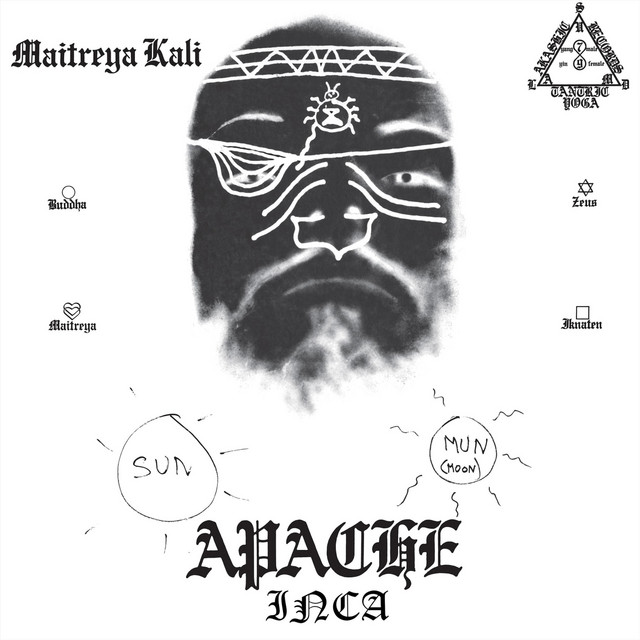
Even after these rare albums were issued on CD, the history of Maitreya Kali was so murky and the details on the albums themselves so muddled that it was impossible to pin down when the records were recorded and who played on them. The clues that could be assembled were drawn largely from the record covers, which are crudely patched together from photos of the apparent perpetuator, taken on his travels around the world; hand-drawn inscrutable symbols for religious deities and planetary bodies; and rambling written dedications and musician credits. But in the early 2000s, a few of the musicians were tracked down, putting some logical rationale behind the apparent madness.
Maitreya Kali was a pseudonym for Craig Smith, a guitarist and songwriter who actually had some quite mainstream artists cover several of his compositions. Smith/Maitreya Kali inaccurately wrote in the liner notes to the first of those records, Apache (1971), that he did all instruments and vocals. Various famous people are mentioned as friends and cohorts in the liner notes, including <a href="spotify:artist:5Tic1bWAbmRoLrqaJ5SxU2">Mike Nesmith</a>, session musician Steve Douglas, producer <a href="spotify:artist:0DWKqGFR1sBGqLT30B9ttc">Nick Venet</a>, and <a href="spotify:artist:6ra4GIOgCZQZMOaUECftGN">Frank Zappa</a> (a handwritten comment by <a href="spotify:artist:6ra4GIOgCZQZMOaUECftGN">Zappa</a> about one Maitreya Kali song is reproduced on the cover of Apache). There are prominent dedications to <a href="spotify:artist:776Uo845nYHJpNaStv1Ds4">Jimi Hendrix</a>, <a href="spotify:artist:6v8FB84lnmJs434UJf2Mrm">Neil Young</a>, "Lord and Lady Lennon," and <a href="spotify:artist:1iQbAecYvKMXhpaFg7oSRq">Paul Butterfield</a> without any certain evidence that he knew any of those musicians. (The <a href="spotify:artist:6v8FB84lnmJs434UJf2Mrm">Neil Young</a> reference makes sense given that a few of the songs mildly recall <a href="spotify:artist:6v8FB84lnmJs434UJf2Mrm">Young</a>'s work in his <a href="spotify:artist:3eskO5m0H4yiF64vRySBjr">Buffalo Springfield</a> days.) There are quotes, some (whether they were real or not) about Maitreya Kali from Batman star Adam West, <a href="spotify:artist:3QDaXfnxfQqqJQK5lSdjLN">Jerry Garcia</a>, <a href="spotify:artist:1ALiu7S9gPJPSw122Ds1t2">Charles Manson</a>, <a href="spotify:artist:4sj6D0zlMOl25nprDJBiU9">Andy Williams</a>, and <a href="spotify:artist:4XN18j3qfTGghKvcCew5QV">Bobby Troup</a>. The liner notes are in a scrambled syntax that only renders them inscrutable, but is of a style that one associates with the mentally ill.
For all that, however, the music is often fairly well-produced, well-played, and likable, not at all the kind of acid-damaged mush you'd suspect from the packaging. This is for the prosaic reason that these songs, comprising about half of the LPs, were unreleased recordings done by <a href="spotify:artist:18ACdWV5lzqWeqG6ZjT5sJ">the Penny Arkade</a> in 1967, before Smith traveled around the world and got much weirder. There are more specific details in <a href="spotify:artist:18ACdWV5lzqWeqG6ZjT5sJ">the Penny Arkade</a> entry, but basically, that group recorded quite a bit of material that never came out, produced by <a href="spotify:artist:5Tic1bWAbmRoLrqaJ5SxU2">Mike Nesmith</a> of <a href="spotify:artist:320EPCSEezHt1rtbfwH6Ck">the Monkees</a>. Smith was not the sole singer/songwriter of that band; he shared equal time with Chris Ducey, with whom he'd done an obscure single for Capitol in 1966 as half of the duo Chris and Craig.
When <a href="spotify:artist:18ACdWV5lzqWeqG6ZjT5sJ">the Penny Arkade</a> broke up without having released anything, Smith took off on travels around the world, funded by his songwriting royalties from covers of his songs by <a href="spotify:artist:320EPCSEezHt1rtbfwH6Ck">the Monkees</a> ("Salesman"), <a href="spotify:artist:4sj6D0zlMOl25nprDJBiU9">Andy Williams</a> ("Holly"), and <a href="spotify:artist:59hLmB5DrdihCYtNeFeW1U">Glen Campbell</a> ("Country Girl"). (The Penny Arkade versions of both "Salesman" and "Country Girl" can be heard on the Inca and Apache albums, respectively.) When he returned to the States, he combined a bunch of unreleased <a href="spotify:artist:18ACdWV5lzqWeqG6ZjT5sJ">Penny Arkade</a> tracks with more recent, sparer, and spookier recordings he'd done on his own, most likely in the early '70s. The results were the Apache and Inca LPs, pressed in extremely small quantities, essentially as vanity pressings credited to Satya Sai Maitreya Kali. An even rarer release put both LPs together onto a double album.
Those who knew Smith felt he'd become much more eccentric and psychologically unstable, a supposition borne out by the eerie nature of the solo recordings on those LPs. To make matters more confusing, the liner notes of Inca claim that the material was recorded over a period of ten years, although it seems unlikely that any of it was done before the mid-'60s. Finally, the albums have also been credited to Satya Sai Maitreya Kali, although they are usually classified in the few discographies that list them as albums by Maitreya Kali, alphabetized under "M."
These extremely rare records developed a reputation among very, very hardcore psychedelic collectors, the kind that have records very few people have ever physically seen, let alone heard. Now the interesting, though not genius, work of Maitreya Kali can be heard on a double-CD reissue on Normal/Shadoks that pairs Apache with Inca. ~ Richie Unterberger, Rovi
The acoustic cuts, while still pretty, are a bit creepy and odd in the manner of a somewhat less cutting-edge <a href="spotify:artist:1BMoKvhibzf1DG39iBkxiI">Dino Valente</a> or Skip Spence. "Love and pain are one and the same," sings the vocalist on "Ole Man," a sentiment that, like some others heard in other songs on the two LPs, gets a little too close to <a href="spotify:artist:1ALiu7S9gPJPSw122Ds1t2">Charles Manson</a> territory for comfort. There are also some pretty ambitious meditations upon religion, loneliness, and mysticism, although in general the tone is upbeat, the melodies accessible, and the singing pleasantly normal. But why, you may be wondering, all this ambiguity? Why not name the personnel of anyone in this act, and why refer to these early-'70s albums as late-'60s rock?
There is one quite simple reason for the wide disparity between the more straightforward full-band electric rock cuts and the lower, more minimally arranged acoustic ones. The electric material -- about half of the Maitreya Kali records -- was not recorded by Maitreya Kali, but by a Southern Californian 1967 pop-folk-rock-psychedelic band, <a href="spotify:artist:18ACdWV5lzqWeqG6ZjT5sJ">the Penny Arkade</a>. And the rest of the songs were recorded a few years later by one of the two singer/songwriters in <a href="spotify:artist:18ACdWV5lzqWeqG6ZjT5sJ">the Penny Arkade</a>, Craig Smith, aka Maitreya Kali.
Even after these rare albums were issued on CD, the history of Maitreya Kali was so murky and the details on the albums themselves so muddled that it was impossible to pin down when the records were recorded and who played on them. The clues that could be assembled were drawn largely from the record covers, which are crudely patched together from photos of the apparent perpetuator, taken on his travels around the world; hand-drawn inscrutable symbols for religious deities and planetary bodies; and rambling written dedications and musician credits. But in the early 2000s, a few of the musicians were tracked down, putting some logical rationale behind the apparent madness.
Maitreya Kali was a pseudonym for Craig Smith, a guitarist and songwriter who actually had some quite mainstream artists cover several of his compositions. Smith/Maitreya Kali inaccurately wrote in the liner notes to the first of those records, Apache (1971), that he did all instruments and vocals. Various famous people are mentioned as friends and cohorts in the liner notes, including <a href="spotify:artist:5Tic1bWAbmRoLrqaJ5SxU2">Mike Nesmith</a>, session musician Steve Douglas, producer <a href="spotify:artist:0DWKqGFR1sBGqLT30B9ttc">Nick Venet</a>, and <a href="spotify:artist:6ra4GIOgCZQZMOaUECftGN">Frank Zappa</a> (a handwritten comment by <a href="spotify:artist:6ra4GIOgCZQZMOaUECftGN">Zappa</a> about one Maitreya Kali song is reproduced on the cover of Apache). There are prominent dedications to <a href="spotify:artist:776Uo845nYHJpNaStv1Ds4">Jimi Hendrix</a>, <a href="spotify:artist:6v8FB84lnmJs434UJf2Mrm">Neil Young</a>, "Lord and Lady Lennon," and <a href="spotify:artist:1iQbAecYvKMXhpaFg7oSRq">Paul Butterfield</a> without any certain evidence that he knew any of those musicians. (The <a href="spotify:artist:6v8FB84lnmJs434UJf2Mrm">Neil Young</a> reference makes sense given that a few of the songs mildly recall <a href="spotify:artist:6v8FB84lnmJs434UJf2Mrm">Young</a>'s work in his <a href="spotify:artist:3eskO5m0H4yiF64vRySBjr">Buffalo Springfield</a> days.) There are quotes, some (whether they were real or not) about Maitreya Kali from Batman star Adam West, <a href="spotify:artist:3QDaXfnxfQqqJQK5lSdjLN">Jerry Garcia</a>, <a href="spotify:artist:1ALiu7S9gPJPSw122Ds1t2">Charles Manson</a>, <a href="spotify:artist:4sj6D0zlMOl25nprDJBiU9">Andy Williams</a>, and <a href="spotify:artist:4XN18j3qfTGghKvcCew5QV">Bobby Troup</a>. The liner notes are in a scrambled syntax that only renders them inscrutable, but is of a style that one associates with the mentally ill.
For all that, however, the music is often fairly well-produced, well-played, and likable, not at all the kind of acid-damaged mush you'd suspect from the packaging. This is for the prosaic reason that these songs, comprising about half of the LPs, were unreleased recordings done by <a href="spotify:artist:18ACdWV5lzqWeqG6ZjT5sJ">the Penny Arkade</a> in 1967, before Smith traveled around the world and got much weirder. There are more specific details in <a href="spotify:artist:18ACdWV5lzqWeqG6ZjT5sJ">the Penny Arkade</a> entry, but basically, that group recorded quite a bit of material that never came out, produced by <a href="spotify:artist:5Tic1bWAbmRoLrqaJ5SxU2">Mike Nesmith</a> of <a href="spotify:artist:320EPCSEezHt1rtbfwH6Ck">the Monkees</a>. Smith was not the sole singer/songwriter of that band; he shared equal time with Chris Ducey, with whom he'd done an obscure single for Capitol in 1966 as half of the duo Chris and Craig.
When <a href="spotify:artist:18ACdWV5lzqWeqG6ZjT5sJ">the Penny Arkade</a> broke up without having released anything, Smith took off on travels around the world, funded by his songwriting royalties from covers of his songs by <a href="spotify:artist:320EPCSEezHt1rtbfwH6Ck">the Monkees</a> ("Salesman"), <a href="spotify:artist:4sj6D0zlMOl25nprDJBiU9">Andy Williams</a> ("Holly"), and <a href="spotify:artist:59hLmB5DrdihCYtNeFeW1U">Glen Campbell</a> ("Country Girl"). (The Penny Arkade versions of both "Salesman" and "Country Girl" can be heard on the Inca and Apache albums, respectively.) When he returned to the States, he combined a bunch of unreleased <a href="spotify:artist:18ACdWV5lzqWeqG6ZjT5sJ">Penny Arkade</a> tracks with more recent, sparer, and spookier recordings he'd done on his own, most likely in the early '70s. The results were the Apache and Inca LPs, pressed in extremely small quantities, essentially as vanity pressings credited to Satya Sai Maitreya Kali. An even rarer release put both LPs together onto a double album.
Those who knew Smith felt he'd become much more eccentric and psychologically unstable, a supposition borne out by the eerie nature of the solo recordings on those LPs. To make matters more confusing, the liner notes of Inca claim that the material was recorded over a period of ten years, although it seems unlikely that any of it was done before the mid-'60s. Finally, the albums have also been credited to Satya Sai Maitreya Kali, although they are usually classified in the few discographies that list them as albums by Maitreya Kali, alphabetized under "M."
These extremely rare records developed a reputation among very, very hardcore psychedelic collectors, the kind that have records very few people have ever physically seen, let alone heard. Now the interesting, though not genius, work of Maitreya Kali can be heard on a double-CD reissue on Normal/Shadoks that pairs Apache with Inca. ~ Richie Unterberger, Rovi
Monthly Listeners
770
Monthly Listeners History
Track the evolution of monthly listeners over the last 28 days.
Followers
734
Followers History
Track the evolution of followers over the last 28 days.
Top Cities
37 listeners

20 listeners

16 listeners
15 listeners

13 listeners
Related Artists
The George-Edwards Group

Bill Stone

Ora


Puff
Stone Harbour


MIJ
Fallen Angels


