Data may be outdated
Last updated: 8 months ago — Click refresh to get the latest statistics.
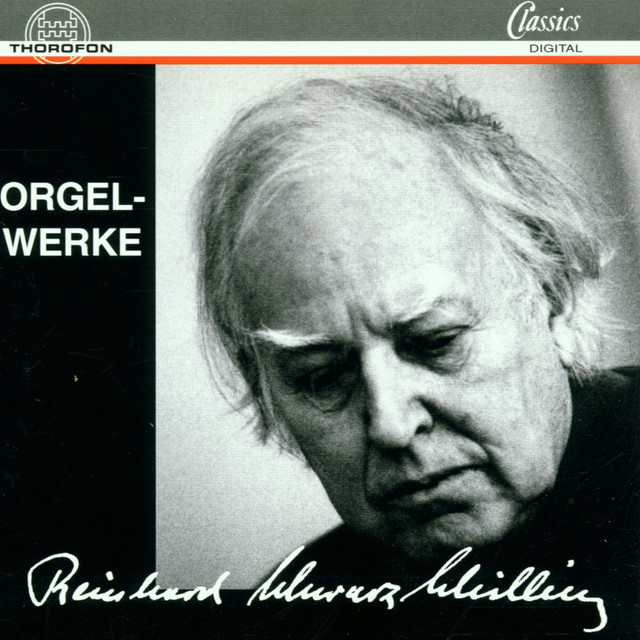
Reinhard Schwarz-Schilling was the longest lived and most ardent disciple of pedagogue and composer <a href="spotify:artist:5JphnEjD8K5jNTcymzarm2">Heinrich Kaminski</a>, who had developed what he felt was a perfect stylistic synthesis of Germanic polyphony stemming from <a href="spotify:artist:5aIqB5nVVvmFsvSdExz408">Bach</a> to <a href="spotify:artist:2bM3j1JQWBkmzuoZKu4zj2">Bruckner</a>. Born in Hanover, Schwarz-Schilling initially studied with <a href="spotify:artist:3koIWgV5GAqdffPubTf2bi">Walter Braunfels</a>, who recommended him to <a href="spotify:artist:5JphnEjD8K5jNTcymzarm2">Kaminski</a>; Schwarz-Schilling's early works, such as the String Quartet in F minor (1932) and Partita for Orchestra (1935), gained considerable attention in Germany before the rise of National Socialism brought cultural developments there to a halt. In 1929, Schwarz-Schilling had married Polish pianist Dusza von Hakrid, whose slight Jewish ancestry would prove a secret so dangerous Schwarz-Schilling carried it with him to his grave; his son -- the prominent German politician Christian Schwarz-Schilling -- would not learn of it until after his father died.
<a href="spotify:artist:5JphnEjD8K5jNTcymzarm2">Heinrich Kaminski</a> was so concerned with the integrity of his circle that he founded a secret society, the "Order of Those who Love," as a means to protect his disciples during the period of National Socialism; on the contrary, all suffered, and <a href="spotify:artist:5JphnEjD8K5jNTcymzarm2">Kaminski</a>'s favorite student, <a href="spotify:artist:6m2G7nbQLEX5FFxhEMQHQt">Heinz Schubert</a>, died on the field of battle. When <a href="spotify:artist:5JphnEjD8K5jNTcymzarm2">Kaminski</a> himself died in 1946, Schwarz-Schilling remained as the sole living representative of the school and spent the rest of his life remaining true to it, despite when developments in the European music that surrounded him moved in entirely different directions. Along the way, Schwarz-Schilling composed two symphonies, the Sinfonia diatonica (1957) and the Symphony in C (1963), chamber music, and much sacred music, including his best-known work, the cantata Die Botschaft (1982).
<a href="spotify:artist:5JphnEjD8K5jNTcymzarm2">Heinrich Kaminski</a> was so concerned with the integrity of his circle that he founded a secret society, the "Order of Those who Love," as a means to protect his disciples during the period of National Socialism; on the contrary, all suffered, and <a href="spotify:artist:5JphnEjD8K5jNTcymzarm2">Kaminski</a>'s favorite student, <a href="spotify:artist:6m2G7nbQLEX5FFxhEMQHQt">Heinz Schubert</a>, died on the field of battle. When <a href="spotify:artist:5JphnEjD8K5jNTcymzarm2">Kaminski</a> himself died in 1946, Schwarz-Schilling remained as the sole living representative of the school and spent the rest of his life remaining true to it, despite when developments in the European music that surrounded him moved in entirely different directions. Along the way, Schwarz-Schilling composed two symphonies, the Sinfonia diatonica (1957) and the Symphony in C (1963), chamber music, and much sacred music, including his best-known work, the cantata Die Botschaft (1982).
Monthly Listeners
804
Monthly Listeners History
Track the evolution of monthly listeners over the last 28 days.
Followers
48
Followers History
Track the evolution of followers over the last 28 days.
Top Cities
3 listeners

Related Artists
Hermann Reutter

Robert Gund
Johann Mayrhofer
Robert Franz

Édouard Lassen
Wilhelm Müller

Eduard Mörike

Felix Dapoz
Ann Schein
Hermann von Gilm
Irmgard Poppen

John Ken NUZZO

The Aldeburgh Connection

Wilhelm Baumgartner

Iván Paley
Friedrich von Matthisson
manabu matsukawa