Data may be outdated
Last updated: 7 months ago — Click refresh to get the latest statistics.
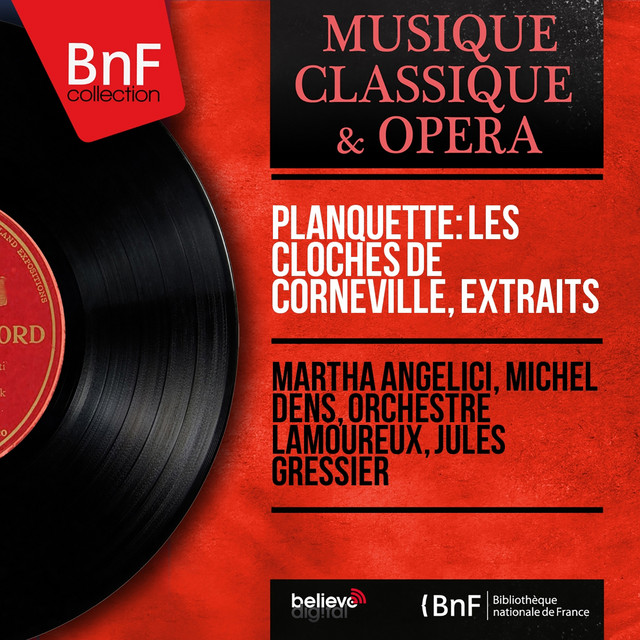
Composer Robert Planquette created operettas that were as successful in London as in Paris, in some cases even more so. He was one of the most celebrated French operetta composers of the late 19th century. Among his works was one in English based on the American tale of Rip Van Winkle. Although stagings and recordings of his work are infrequent, Planquette's music is still known today; the overture to his opéra comique Les cloches de Corneville was included on a 2024 recording of French opera overtures led by conductor <a href="spotify:artist:5UHZvYJA0aPcJSLYkYAeps">Neeme Järvi</a>.
Jean Robert Planquette was born July 31, 1848, in Paris. His father was a singer. He showed musical talent while he was young and entered the Conservatoire de Paris, but a lack of money forced him to withdraw before graduating. Planquette eked out a living as a pianist in cafés and as a singer; he had a strong tenor voice. His first success as a composer came with a song, Sambre et Meuse, that was performed regularly by the soon-to-be-famous opera singer Lucien Fugère. Planquette scored a major breakthrough in 1876 when he was commissioned to write an operetta by the director of the Théâtre des Folies-Dramatiques; Les cloches de Corneville ran for an impressive 480 performances in Paris. A London production scored an even longer run with 708 performances.
Several more Planquette operettas went on to have long runs in London as well as Paris, including Les voltigeurs du 32ième (1880), translated into English as The Old Guard. Especially notable was Rip Van Winkle (1882), which was written in English by Henri Meilhac, Philippe Gille, and Henry Brougham Farnie and produced for the first time in London, although a French version later appeared in Paris. Planquette continued to write operettas with varying degrees of success through the 1890s; his works include Surcouf (1887), translated as Paul Jones in 1889; Captain Thérèse, which also had its first performance in London (in 1887); and Le Talisman (1892). Most seasons in Paris between 1878 and 1897 saw the appearance of a new Planquette opera. In later life, he served as a city council member in Cabourg, in Normandy. He died in Paris on January 28, 1903.
Performances and recordings of Planquette's operettas have been rare compared with those of <a href="spotify:artist:4OihBPCQzR4GfbzqOY69Xm">Offenbach</a>, but Les cloches de Corneville has been recorded multiple times (its overture appeared on a 2024 <a href="spotify:search:label%3A%22Chandos%22">Chandos</a> album of French opera overtures by the <a href="spotify:artist:3wnm0pkc0sPfV7UI2xlZlW">Estonian National Symphony</a> under the baton of <a href="spotify:artist:5UHZvYJA0aPcJSLYkYAeps">Neeme Järvi</a>), and a march called Le régiment de Sambre et Muse is performed to this day by the <a href="spotify:artist:555069AxgdlH7dl3ukV4An">Ohio State University Marching Band</a> during the realization of its script "Ohio" on the football field. ~ James Manheim, Rovi
Jean Robert Planquette was born July 31, 1848, in Paris. His father was a singer. He showed musical talent while he was young and entered the Conservatoire de Paris, but a lack of money forced him to withdraw before graduating. Planquette eked out a living as a pianist in cafés and as a singer; he had a strong tenor voice. His first success as a composer came with a song, Sambre et Meuse, that was performed regularly by the soon-to-be-famous opera singer Lucien Fugère. Planquette scored a major breakthrough in 1876 when he was commissioned to write an operetta by the director of the Théâtre des Folies-Dramatiques; Les cloches de Corneville ran for an impressive 480 performances in Paris. A London production scored an even longer run with 708 performances.
Several more Planquette operettas went on to have long runs in London as well as Paris, including Les voltigeurs du 32ième (1880), translated into English as The Old Guard. Especially notable was Rip Van Winkle (1882), which was written in English by Henri Meilhac, Philippe Gille, and Henry Brougham Farnie and produced for the first time in London, although a French version later appeared in Paris. Planquette continued to write operettas with varying degrees of success through the 1890s; his works include Surcouf (1887), translated as Paul Jones in 1889; Captain Thérèse, which also had its first performance in London (in 1887); and Le Talisman (1892). Most seasons in Paris between 1878 and 1897 saw the appearance of a new Planquette opera. In later life, he served as a city council member in Cabourg, in Normandy. He died in Paris on January 28, 1903.
Performances and recordings of Planquette's operettas have been rare compared with those of <a href="spotify:artist:4OihBPCQzR4GfbzqOY69Xm">Offenbach</a>, but Les cloches de Corneville has been recorded multiple times (its overture appeared on a 2024 <a href="spotify:search:label%3A%22Chandos%22">Chandos</a> album of French opera overtures by the <a href="spotify:artist:3wnm0pkc0sPfV7UI2xlZlW">Estonian National Symphony</a> under the baton of <a href="spotify:artist:5UHZvYJA0aPcJSLYkYAeps">Neeme Järvi</a>), and a march called Le régiment de Sambre et Muse is performed to this day by the <a href="spotify:artist:555069AxgdlH7dl3ukV4An">Ohio State University Marching Band</a> during the realization of its script "Ohio" on the football field. ~ James Manheim, Rovi
Monthly Listeners
568
Monthly Listeners History
Track the evolution of monthly listeners over the last 28 days.
Followers
99
Followers History
Track the evolution of followers over the last 28 days.
Top Cities
14 listeners

11 listeners

7 listeners

7 listeners

6 listeners

Related Artists

Les gardiens de la paix

Christoph Walter
Musique Des Gardiens De La Paix De Paris

Désiré Cartierre

François-Julien Brun

Albert Gossez

The Royal Marines Band Of The Royal New Zealand Navy
Richard Franko Goldman
Семен Чернецкий

Adolphe Sellenick
Pride of '48 Band

The Vienna Police Band

Anthems
Militärkapelle Rudolf Rieger

Band of the Royal Netherlands Navy

Koninklijke harmonie Sainte Cecile Eijsden
Jean-Valentin Bender
S. Poulain

Military Orchestra
J. Redouté

Christoph Walter Marschorchester & Chor

The Deutschmeister Band
The Band Of The Royal Military Academy

Prodhomme

Das große Blasorchester Berlin

Jakob Pazeller

Musikkorps Der 11 Panzer-Grenadier-Division

Deutschmeister Band

Musique de la Garde Napoléonienne

National Concert Band of America
A. Quinet

Banda de Conciertos de la IV División de Ejército

Arthur Prevost
Blasorchester Zürileu
