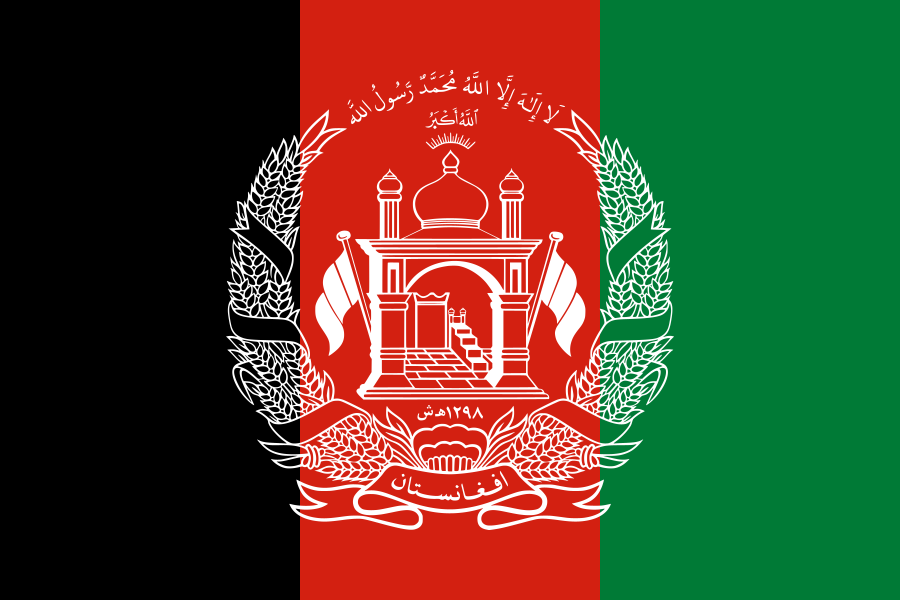
Country
Afghanistan
Top Artists from Afghanistan
Showing 5 of 5 artists

About Afghanistan
Afghanistan is a country of towering mountains, sun-scorched deserts, and centuries of cultural cross-pollination. In cities like Kabul, Herat, and Mazar-i-Sharif, music threads through daily life—from dawn prayers and wedding celebrations to tea-house gatherings and street performances. For music enthusiasts, Afghanistan offers a living archive: a place where ancient melodies endure while modern voices experiment with new textures and languages, blending folk, classical, and contemporary forms into a distinct auditory tapestry.
Today the country is home to roughly 40 million people, with Dari and Pashto the two dominant languages. Afghan music famously centers the rubab, a lute-like instrument with a resonant, expressive voice, paired with percussion such as the tabla or a delicate frame drum. Vocals often draw on the rich tradition of Persian poetry and Sufi-inspired devotion, delivering intimate ghazals, ballads, and hero-songs that celebrate love, longing, and resilience. The result is a sound world that feels both ancient and urgently contemporary. Young ensembles mix rubab and other traditional instruments with modern textures, creating cinematic soundscapes that appear in films and online videos, expanding Afghanistan’s reach beyond geographic borders.
Among the most enduring figures in Afghan music is Ahmad Zahir, often hailed as the turning point between traditional royal court singing and modern Afghan pop. His songs remain a cultural touchstone across generations and continue to shape how new listeners imagine the country’s musical identity. In more recent times, Farhad Darya has become a household name, bridging pop spectacle with film and television projects, while Aryana Sayeed has emerged as a global ambassador for Afghan pop and a steadfast advocate for women’s voices in music. Legendary female vocalist Naghma is celebrated for her long career and unmistakable timbre, carrying the tradition forward through decades of performance and recording, both in Afghanistan and in the diaspora. Beyond these icons, a rising generation of young singers and instrumentalists—many performing in Kabul’s private salons, community centers, and diaspora venues—keeps the flame alive with energy, experimentation, and a readiness to cross borders.
An important institution shaping the new generation is the Afghanistan National Institute of Music (ANIM) in Kabul. Founded to preserve Afghan musical heritage while embracing international collaborations, ANIM trains young instrumentalists and vocalists side by side and has staged performances that travel to Europe and North America through outreach programs. Outside formal education, concerts, weddings, and cultural centers—often at gardens, mosques, or university venues—keep the music thriving, with communities sharing tunes in a generous, communal spirit. ANIM’s choir and symphonic projects have expanded Afghan participation on the world stage and inspired collaborations that highlight the country’s rich musical vocabulary.
Afghan music has also left a broad regional imprint, drawing on Persian classical traditions, Central Asian rhythms, and South Asian film and pop aesthetics. The result is a living, evolving sound that continues to inspire listeners and musicians far beyond Afghanistan’s borders. For music lovers, the country offers a compelling blend of history, craft, and risk-taking—an invitation to listen deeply to a culture where song remains a vital form of memory, identity, and hope.
Today the country is home to roughly 40 million people, with Dari and Pashto the two dominant languages. Afghan music famously centers the rubab, a lute-like instrument with a resonant, expressive voice, paired with percussion such as the tabla or a delicate frame drum. Vocals often draw on the rich tradition of Persian poetry and Sufi-inspired devotion, delivering intimate ghazals, ballads, and hero-songs that celebrate love, longing, and resilience. The result is a sound world that feels both ancient and urgently contemporary. Young ensembles mix rubab and other traditional instruments with modern textures, creating cinematic soundscapes that appear in films and online videos, expanding Afghanistan’s reach beyond geographic borders.
Among the most enduring figures in Afghan music is Ahmad Zahir, often hailed as the turning point between traditional royal court singing and modern Afghan pop. His songs remain a cultural touchstone across generations and continue to shape how new listeners imagine the country’s musical identity. In more recent times, Farhad Darya has become a household name, bridging pop spectacle with film and television projects, while Aryana Sayeed has emerged as a global ambassador for Afghan pop and a steadfast advocate for women’s voices in music. Legendary female vocalist Naghma is celebrated for her long career and unmistakable timbre, carrying the tradition forward through decades of performance and recording, both in Afghanistan and in the diaspora. Beyond these icons, a rising generation of young singers and instrumentalists—many performing in Kabul’s private salons, community centers, and diaspora venues—keeps the flame alive with energy, experimentation, and a readiness to cross borders.
An important institution shaping the new generation is the Afghanistan National Institute of Music (ANIM) in Kabul. Founded to preserve Afghan musical heritage while embracing international collaborations, ANIM trains young instrumentalists and vocalists side by side and has staged performances that travel to Europe and North America through outreach programs. Outside formal education, concerts, weddings, and cultural centers—often at gardens, mosques, or university venues—keep the music thriving, with communities sharing tunes in a generous, communal spirit. ANIM’s choir and symphonic projects have expanded Afghan participation on the world stage and inspired collaborations that highlight the country’s rich musical vocabulary.
Afghan music has also left a broad regional imprint, drawing on Persian classical traditions, Central Asian rhythms, and South Asian film and pop aesthetics. The result is a living, evolving sound that continues to inspire listeners and musicians far beyond Afghanistan’s borders. For music lovers, the country offers a compelling blend of history, craft, and risk-taking—an invitation to listen deeply to a culture where song remains a vital form of memory, identity, and hope.