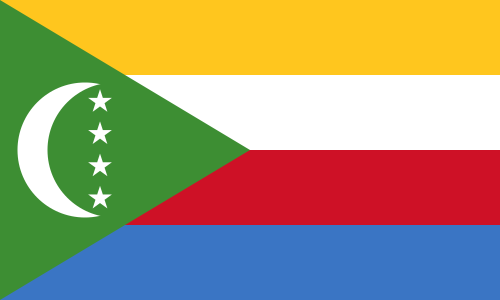
Country
Comoros
Top Artists from Comoros
No artists found
No artists from Comoros are currently tracked.
About Comoros
Comoros, officially the Union of the Comoros, is a tiny archipelago in the Indian Ocean, tucked between the African coast and Madagascar. It comprises four main islands—Grande Comore (Ngazidja), Mohéli (Mwali), Anjouan (Ndzouani)—while Mayotte sits nearby as a French department rather than part of the Union. The country is home to roughly 1 million people, a population that keeps the islands vibrant with a shared love for rhythm, storytelling, and communal song.
For music enthusiasts, Comoros offers a living bridge between Africa, the Arab world, and the Indian Ocean. The traditional Malouf music, rooted in Andalusian and Arab-Maghrebi influences, remains the heartbeat of cultural life. Malouf is performed in ensembles that blend strings, percussion, and wind, and sung in Shikomori, the local language continuum that blends Arabic, Swahili, and French. The melodies are often intricate, marked by graceful ornamentation and a call-and-response flow that invites listeners to participate. Beyond Malouf, contemporary styles blossom on the islands, with artists blending traditional chants with pop, reggae, and hip-hop influences, reflecting the Comoros’ status as a crossroads of cultures.
In performance, the music scene favors communal experiences. Weddings, religious and cultural ceremonies, and neighborhood nights provide stage-like settings where the line between performer and audience dissolves. Instrumental color can include the oud or similar strings, a variety of percussion, and occasionally violin or wind instruments, all woven into arranged pieces or spontaneous jams. The vocal tradition is known for its polyphonic and resonant singing, often featuring harmonies that rise and fall with the rhythm of the drum. This approach has contributed a distinctive flavor to regional circuits, influencing neighboring islands and diaspora communities abroad.
Popular events on the islands celebrate heritage and musical exchange. Programming varies with local life, but nights in Moroni and coastal towns frequently showcase Malouf ensembles, new-song collaborations, and community performances that bring together families, traders, and travelers. Festivals—where traditional songs rub shoulders with modern compositions—underscore Comoros’ role in the broader Indian Ocean music ecosystem. Even when big stages aren’t available, the informal concert in a village square or a harbor often ends with a chorus that lingers in the evening air.
As a result, Comorian music has become a beacon for those exploring the fusion of old-world modes with contemporary sound. The country’s influence reaches into the Comorian diaspora in France, Madagascar, and across East Africa, helping to spread a sensibility that values storytelling, rhythm, and resilience. If you’re listening for a sound that marries maritime nostalgia with modern curiosity, Comoros offers a resonant, ever-evolving chorus.
Note: If you’d like, I can tailor this further with specific artist names, festival dates, or venues based on the latest information you want included.
For music enthusiasts, Comoros offers a living bridge between Africa, the Arab world, and the Indian Ocean. The traditional Malouf music, rooted in Andalusian and Arab-Maghrebi influences, remains the heartbeat of cultural life. Malouf is performed in ensembles that blend strings, percussion, and wind, and sung in Shikomori, the local language continuum that blends Arabic, Swahili, and French. The melodies are often intricate, marked by graceful ornamentation and a call-and-response flow that invites listeners to participate. Beyond Malouf, contemporary styles blossom on the islands, with artists blending traditional chants with pop, reggae, and hip-hop influences, reflecting the Comoros’ status as a crossroads of cultures.
In performance, the music scene favors communal experiences. Weddings, religious and cultural ceremonies, and neighborhood nights provide stage-like settings where the line between performer and audience dissolves. Instrumental color can include the oud or similar strings, a variety of percussion, and occasionally violin or wind instruments, all woven into arranged pieces or spontaneous jams. The vocal tradition is known for its polyphonic and resonant singing, often featuring harmonies that rise and fall with the rhythm of the drum. This approach has contributed a distinctive flavor to regional circuits, influencing neighboring islands and diaspora communities abroad.
Popular events on the islands celebrate heritage and musical exchange. Programming varies with local life, but nights in Moroni and coastal towns frequently showcase Malouf ensembles, new-song collaborations, and community performances that bring together families, traders, and travelers. Festivals—where traditional songs rub shoulders with modern compositions—underscore Comoros’ role in the broader Indian Ocean music ecosystem. Even when big stages aren’t available, the informal concert in a village square or a harbor often ends with a chorus that lingers in the evening air.
As a result, Comorian music has become a beacon for those exploring the fusion of old-world modes with contemporary sound. The country’s influence reaches into the Comorian diaspora in France, Madagascar, and across East Africa, helping to spread a sensibility that values storytelling, rhythm, and resilience. If you’re listening for a sound that marries maritime nostalgia with modern curiosity, Comoros offers a resonant, ever-evolving chorus.
Note: If you’d like, I can tailor this further with specific artist names, festival dates, or venues based on the latest information you want included.