Country
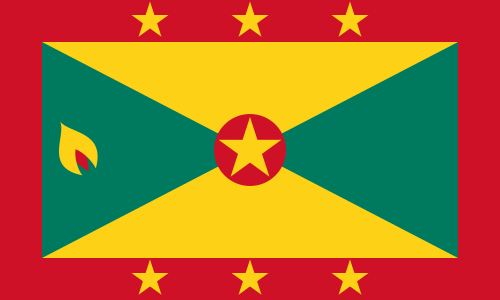
Grenada
Top Artists from Grenada
Showing 5 of 5 artists





About Grenada
Grenada, the emerald isle of the Southern Caribbean, is a compact canvas of rain-forested hills, spice-scented air, and a coastline that glitters with turquoise bays. For music lovers, it’s a place where rhythm threads through daily life—from open-air jams on the Carenage in St. George’s to the thunderous celebrations of festival streets. The island’s sound is a lively blend of calypso, soca, reggae, and dancehall, seasoned with brass hooks, pulsing basslines, and call-and-response choruses that invite participation as much as listening.
Today, Grenada is home to roughly 112,000 people. Population size matters less than the way the island’s communities rally around maker-and-musician networks: local bands busking on corner sidewalks, sound systems rolling through coastal towns, and youth programs fostering performance and songwriting. The result is a resilient music scene that feels both intimate and expansive, with artists who cultivate a distinctly Grenadian voice while engaging with the wider Caribbean and global music currents.
If you’re scanning Grenadian music history for names you may recognize, you’ll likely encounter Rupee, whose Tempted to Touch helped push Grenadian soca toward international audiences in the mid-2000s. Another figure often associated with Grenada’s rhythmic identity is Arrow, a legendary name in the soca/calypso world whose energetic party anthems helped popularize a certain carnival-era sound well beyond the island. These artists aren’t just one-off hits; they’re touchpoints for a tradition that prizes exuberant performance, melodic hooks, and a capacity to turn a harborfront stage into a spirited dance floor.
Spicemas Carnival, Grenada’s August festival, stands as the centerpiece of the island’s musical calendar. It’s a multi-day immersion into calypso and soca competition, street parades, and large-scale concerts that storm the towns with confetti, color, and contagious energy. The festival has long served as a launching pad for local talent and a stage where Grenadian rhythms collide with Caribbean trends, sometimes influencing neighboring islands and Caribbean diasporas worldwide. If you’re a music enthusiast, attending Spicemas offers a vivid example of how Grenada shapes and is shaped by Carnival culture, with performers, designers, and musicians turning the entire island into a colossal, pulsating venue.
Venues in Grenada lean toward outdoor, communal experiences: seaside stages along the Carenage, public plazas, and festival grounds where the sea breeze mingles with brass and percussion. The island’s music is also reinforced by a network of clubs, radio programs, and cultural institutions that encourage collaboration among singers, instrumentalists, deejays, and engineers. The result is a sound that feels welcoming, celebratory, and unafraid to push the tempo when the moment calls for it.
For music enthusiasts planning a trip, Grenada offers more than scenery—it's a chance to explore a living, breathing Caribbean soundscape. Listen for the punch of calypso, the swagger of soca, the grounding of reggae, and the communal joy that makes Grenadian music so infectious. The island proves that even a small nation can cast a wide cultural net when rhythm, heritage, and community converge.
Today, Grenada is home to roughly 112,000 people. Population size matters less than the way the island’s communities rally around maker-and-musician networks: local bands busking on corner sidewalks, sound systems rolling through coastal towns, and youth programs fostering performance and songwriting. The result is a resilient music scene that feels both intimate and expansive, with artists who cultivate a distinctly Grenadian voice while engaging with the wider Caribbean and global music currents.
If you’re scanning Grenadian music history for names you may recognize, you’ll likely encounter Rupee, whose Tempted to Touch helped push Grenadian soca toward international audiences in the mid-2000s. Another figure often associated with Grenada’s rhythmic identity is Arrow, a legendary name in the soca/calypso world whose energetic party anthems helped popularize a certain carnival-era sound well beyond the island. These artists aren’t just one-off hits; they’re touchpoints for a tradition that prizes exuberant performance, melodic hooks, and a capacity to turn a harborfront stage into a spirited dance floor.
Spicemas Carnival, Grenada’s August festival, stands as the centerpiece of the island’s musical calendar. It’s a multi-day immersion into calypso and soca competition, street parades, and large-scale concerts that storm the towns with confetti, color, and contagious energy. The festival has long served as a launching pad for local talent and a stage where Grenadian rhythms collide with Caribbean trends, sometimes influencing neighboring islands and Caribbean diasporas worldwide. If you’re a music enthusiast, attending Spicemas offers a vivid example of how Grenada shapes and is shaped by Carnival culture, with performers, designers, and musicians turning the entire island into a colossal, pulsating venue.
Venues in Grenada lean toward outdoor, communal experiences: seaside stages along the Carenage, public plazas, and festival grounds where the sea breeze mingles with brass and percussion. The island’s music is also reinforced by a network of clubs, radio programs, and cultural institutions that encourage collaboration among singers, instrumentalists, deejays, and engineers. The result is a sound that feels welcoming, celebratory, and unafraid to push the tempo when the moment calls for it.
For music enthusiasts planning a trip, Grenada offers more than scenery—it's a chance to explore a living, breathing Caribbean soundscape. Listen for the punch of calypso, the swagger of soca, the grounding of reggae, and the communal joy that makes Grenadian music so infectious. The island proves that even a small nation can cast a wide cultural net when rhythm, heritage, and community converge.