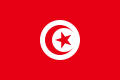
Country
Tunisia
Top Artists from Tunisia
Showing 25 of 41 artists











About Tunisia
Tunisia sits at the hinge of Africa and the Mediterranean, a compact nation whose coastline glints with turquoise and whose interior holds ancient markets, desert winds, and a surprisingly restless soundscape. With about 12 million people, it’s a country where old and new mingle, and every street corner seems to hum with a different rhythm. For music lovers, Tunisia offers a curriculum in sound: a living thread from Andalusian-inspired Malouf to contemporary fusion, jazz-inflected improvisations, and fearless vocal storytelling.
Traditional Tunisian music centers on Malouf, a refined Andalusian classical tradition that traveled here with medieval courts and evolved into a nuanced conversation between oud, violin, qanun, and a vocal line capable of both lament and celebration. In the southern towns, the trance-tinged Stambeli and the wind-and-percussion textures of the mezoued create communal rituals that feel like living archives. Even today, intimate riad courtyards in Tunis and the hill towns around Sousse and Nabeul echo with oud lines and call-and-response phrases that defy easy categorization.
In the modern era, Tunisian voices have become global ambassadors. Emel Mathlouthi—simply Emel—rose to international prominence with Kelmti Horra, an anthem of personal and political freedom that resonated around the world during and after the Arab Spring. Latifa, a towering voice in Arab pop, has shaped contemporary sound with elegant, emotionally direct singing. Ghalia Benali blends Tunisian roots with French and Middle Eastern textures, while Dhafer Youssef and Anouar Brahem—two of the world’s most acclaimed oud players—have woven North African melody into jazz and world music, earning performances at major festivals and on renowned labels.
Tunisia’s festival calendar is a playground for listeners who crave breadth. The Carthage International Festival, staged in the ancient Carthage amphitheatre above Tunis, brings big international stars together with Tunisian masters in a setting that feels almost cinematic. The Douz International Festival in the desert town of Douz pulses with Saharan light, caravans, and music that travels from roots toward contemporary edges. In Tunis, the Municipal Theatre and the Opera House host classical and contemporary programs year-round, while venues like the Théâtre de l’Opéra stand as beacons for opera, symphonic works, and cutting-edge stage pieces.
Tunisia’s music is a bridge—between Maghreb and Europe, between tradition and invention, and between memory and experimentation. Its musicians continue to push boundaries while honoring Malouf’s elegant phrasing, ensuring that every visit feels like stepping into a living concert. For listeners, Tunisia isn’t just a destination; it’s a vivid, evolving sound culminating in a powerful chorus that travels far beyond its shores.
Traditional Tunisian music centers on Malouf, a refined Andalusian classical tradition that traveled here with medieval courts and evolved into a nuanced conversation between oud, violin, qanun, and a vocal line capable of both lament and celebration. In the southern towns, the trance-tinged Stambeli and the wind-and-percussion textures of the mezoued create communal rituals that feel like living archives. Even today, intimate riad courtyards in Tunis and the hill towns around Sousse and Nabeul echo with oud lines and call-and-response phrases that defy easy categorization.
In the modern era, Tunisian voices have become global ambassadors. Emel Mathlouthi—simply Emel—rose to international prominence with Kelmti Horra, an anthem of personal and political freedom that resonated around the world during and after the Arab Spring. Latifa, a towering voice in Arab pop, has shaped contemporary sound with elegant, emotionally direct singing. Ghalia Benali blends Tunisian roots with French and Middle Eastern textures, while Dhafer Youssef and Anouar Brahem—two of the world’s most acclaimed oud players—have woven North African melody into jazz and world music, earning performances at major festivals and on renowned labels.
Tunisia’s festival calendar is a playground for listeners who crave breadth. The Carthage International Festival, staged in the ancient Carthage amphitheatre above Tunis, brings big international stars together with Tunisian masters in a setting that feels almost cinematic. The Douz International Festival in the desert town of Douz pulses with Saharan light, caravans, and music that travels from roots toward contemporary edges. In Tunis, the Municipal Theatre and the Opera House host classical and contemporary programs year-round, while venues like the Théâtre de l’Opéra stand as beacons for opera, symphonic works, and cutting-edge stage pieces.
Tunisia’s music is a bridge—between Maghreb and Europe, between tradition and invention, and between memory and experimentation. Its musicians continue to push boundaries while honoring Malouf’s elegant phrasing, ensuring that every visit feels like stepping into a living concert. For listeners, Tunisia isn’t just a destination; it’s a vivid, evolving sound culminating in a powerful chorus that travels far beyond its shores.