Country
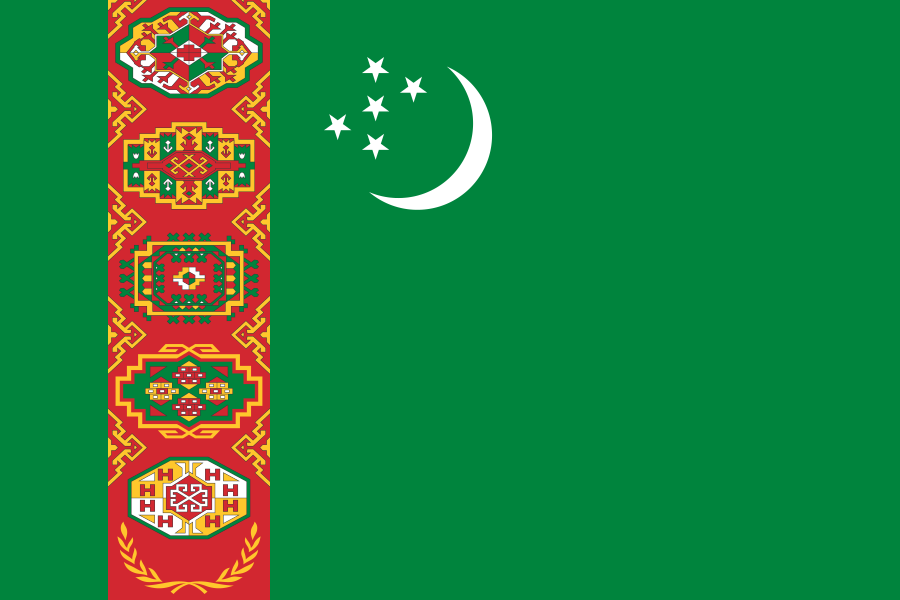
Turkmenistan
Top Artists from Turkmenistan
Showing 3 of 3 artists


About Turkmenistan
Turkmenistan sits at the heart of Central Asia, bordered by the Caspian Sea to the west and the expansive Karakum Desert that covers much of its interior. With a population of about 6 million, the country has cultivated a musical life that reflects its nomadic heritage, Silk Road exchanges, and a modern, state-supported culture. For music enthusiasts, Turkmenistan offers a rooted acoustic tradition alongside contemporary arrangements that keep the tradition alive while inviting new ideas.
The core of Turkmen music rests in melodic storytelling, call-and-response vocals, and instrumental virtuosity. Traditional forms such as mugham and epic ballads mingle with ritual songs performed at weddings and public holidays. The dutar, a two-stringed long-neck instrument, is the heartbeat of many ensembles, its bright plucked lines weaving with the hissing of drone strings. The gidjak or other fiddles, along with frame drums and wooden flutes, are commonly heard in rural performances, while more formal settings lean on choirs and large ensembles.
Important venues anchor Turkmen music in the urban landscape. In Ashgabat, the State Opera and Ballet Theatre and the Turkmen National Conservatory nurture both classical and folk-inflected repertoire. The Turkmen National Philharmonic Hall hosts concerts by symphony orchestras and chamber groups, often featuring Turkmen composers alongside visiting ensembles from across the region. The country’s concert calendar also reflects a strong tradition of state-supported music, with public performances during holidays, harvest festivals, and Navruz celebrations (the Persian New Year) that bring traditional songs, dances, and energetic rhythms to city squares and rural gatherings.
A thriving, if compact, contemporary scene sits beside the centuries-old forms. Turkmen artists who carry the country’s musical heritage into new waters perform in pop, rock, fusion, and world-music contexts across Central Asia and the diaspora. The dutar and gidjak appear not only in folk contexts but in modern arrangements, collaborations, and cross-cultural projects, making Turkmen music audible to listeners who might never travel to the central deserts. There is also a growing network of teachers and conservatory students who blend traditional technique with contemporary composition, fueling a homegrown scene that emphasizes melodic clarity, rhythmic discipline, and expressive ornamentation.
Popular artists and ambassadors of Turkmen music tend to straddle both traditional performance and international collaborations. While the region’s stars may be more widely known in neighboring republics, Turkmen musicians perform at regional festivals and occasionally on international stages, highlighting the country’s unique instrumental sound and vocal color. The influence of Turkmen music on the Central Asian soundscape—especially through the dutar and the call-and-response vocal style—continues to resonate with audiences who savor the warmth of deeply sung melismas, the crisp articulation of folk tunes, and the subtle poetry of Turkmen epic singing.
In short, Turkmenistan offers music enthusiasts a clear lineage—from the dutar’s ringing strings to the stagecraft of its theatres—coupled with contemporary voices pushing the tradition forward. The population of about 6 million shares a national memory where both ritual symbolism and everyday joy are music, and that makes Turkmen music a living conversation between past and present.
The core of Turkmen music rests in melodic storytelling, call-and-response vocals, and instrumental virtuosity. Traditional forms such as mugham and epic ballads mingle with ritual songs performed at weddings and public holidays. The dutar, a two-stringed long-neck instrument, is the heartbeat of many ensembles, its bright plucked lines weaving with the hissing of drone strings. The gidjak or other fiddles, along with frame drums and wooden flutes, are commonly heard in rural performances, while more formal settings lean on choirs and large ensembles.
Important venues anchor Turkmen music in the urban landscape. In Ashgabat, the State Opera and Ballet Theatre and the Turkmen National Conservatory nurture both classical and folk-inflected repertoire. The Turkmen National Philharmonic Hall hosts concerts by symphony orchestras and chamber groups, often featuring Turkmen composers alongside visiting ensembles from across the region. The country’s concert calendar also reflects a strong tradition of state-supported music, with public performances during holidays, harvest festivals, and Navruz celebrations (the Persian New Year) that bring traditional songs, dances, and energetic rhythms to city squares and rural gatherings.
A thriving, if compact, contemporary scene sits beside the centuries-old forms. Turkmen artists who carry the country’s musical heritage into new waters perform in pop, rock, fusion, and world-music contexts across Central Asia and the diaspora. The dutar and gidjak appear not only in folk contexts but in modern arrangements, collaborations, and cross-cultural projects, making Turkmen music audible to listeners who might never travel to the central deserts. There is also a growing network of teachers and conservatory students who blend traditional technique with contemporary composition, fueling a homegrown scene that emphasizes melodic clarity, rhythmic discipline, and expressive ornamentation.
Popular artists and ambassadors of Turkmen music tend to straddle both traditional performance and international collaborations. While the region’s stars may be more widely known in neighboring republics, Turkmen musicians perform at regional festivals and occasionally on international stages, highlighting the country’s unique instrumental sound and vocal color. The influence of Turkmen music on the Central Asian soundscape—especially through the dutar and the call-and-response vocal style—continues to resonate with audiences who savor the warmth of deeply sung melismas, the crisp articulation of folk tunes, and the subtle poetry of Turkmen epic singing.
In short, Turkmenistan offers music enthusiasts a clear lineage—from the dutar’s ringing strings to the stagecraft of its theatres—coupled with contemporary voices pushing the tradition forward. The population of about 6 million shares a national memory where both ritual symbolism and everyday joy are music, and that makes Turkmen music a living conversation between past and present.