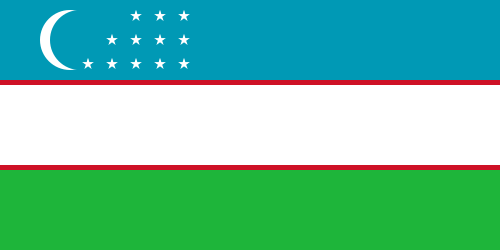
Country
Uzbekistan
Top Artists from Uzbekistan
Showing 22 of 22 artists









About Uzbekistan
Uzbekistan is a country where music is woven into daily life as surely as streets and markets. Home to roughly 34 million people, it has a living tradition that reaches from ancient caravanserais to modern concert halls. For music enthusiasts, Uzbekistan offers a rare blend: centuries-old forms performed with contemporary energy, and a cultural vice-versa of old and new shaping each other.
Central to the Uzbek soundscape is Shashmaqom, a classical courtly tradition rooted in the cities of Bukhara, Samarkand, and Tashkent. This suite of songs and instrumental pieces is built on intricate maqam-based melodies, sung with a refined, ornamental vocal style, and accompanied by traditional instruments such as the dutar (a long-necked lute), tanbur, rubab, and the frame drum doira. Shashmaqom has endured as a symbol of national identity, and its enduring prestige is underscored by UNESCO’s recognition of the tradition as part of the world’s intangible cultural heritage. For listeners, the experience is less a single genre than an immersion in mood, history, and language—music as a bridge between centuries.
The country also boasts vibrant institutional foundations. Tashkent’s Grand Opera and Ballet Theatre and the Alisher Navoi Opera and Ballet Theatre host classical masterpieces, grand symphonies, and visiting orchestras, while the Republic’s music conservatories and universities train generations of performers, composers, and ethnomusicologists. These venues and schools nurture a continuum: from the nuanced intonations of Shashmaqom to contemporary arrangements that experiment with rhythm, texture, and electronic production.
In modern Uzbek music, tradition does not stand apart from popular culture. Yulduz Usmonova is widely regarded as one of Uzbekistan’s most influential contemporary vocalists, whose work spans traditional-inflected pop to modern crossover tunes. Her music, as with Sevara Nazarova’s bold, melodic pop, illustrates how traditional color—microtonal inflection, expressive ornamentation, and melodically generous lines—finds new life in today’s radio, streaming, and festival stages. A new generation of Uzbek artists continues to blend folk timbres with global pop and electronic production, creating sounds that feel distinctly local yet clearly international.
Events and moments of public musical gathering are plentiful. Navruz, the spring festival marking the new year in Central Asia, is celebrated with concerts, street performances, and gatherings that showcase traditional songs alongside contemporary acts. This is a time when folk music, maqom ensembles, and dance come alive in city squares and parks, offering an accessible, communal listening experience for locals and visitors alike. Beyond Navruz, the country hosts jazz and world-music events in Tashkent and other cities, drawing regional and international performers who explore improvisation, fusion, and cross-cultural collaborations.
For those curious about the sound of Central Asia, Uzbekistan is a key stop. Its musical life demonstrates how ancient forms survive and flourish within a modern ecosystem—where a dutar can sit beside a synthesizer, where a maqom cabinet can share the stage with a contemporary ensemble, and where a city’s night air is perfumed with the echo of centuries-old melodies and the pulse of new, restless creativity.
Central to the Uzbek soundscape is Shashmaqom, a classical courtly tradition rooted in the cities of Bukhara, Samarkand, and Tashkent. This suite of songs and instrumental pieces is built on intricate maqam-based melodies, sung with a refined, ornamental vocal style, and accompanied by traditional instruments such as the dutar (a long-necked lute), tanbur, rubab, and the frame drum doira. Shashmaqom has endured as a symbol of national identity, and its enduring prestige is underscored by UNESCO’s recognition of the tradition as part of the world’s intangible cultural heritage. For listeners, the experience is less a single genre than an immersion in mood, history, and language—music as a bridge between centuries.
The country also boasts vibrant institutional foundations. Tashkent’s Grand Opera and Ballet Theatre and the Alisher Navoi Opera and Ballet Theatre host classical masterpieces, grand symphonies, and visiting orchestras, while the Republic’s music conservatories and universities train generations of performers, composers, and ethnomusicologists. These venues and schools nurture a continuum: from the nuanced intonations of Shashmaqom to contemporary arrangements that experiment with rhythm, texture, and electronic production.
In modern Uzbek music, tradition does not stand apart from popular culture. Yulduz Usmonova is widely regarded as one of Uzbekistan’s most influential contemporary vocalists, whose work spans traditional-inflected pop to modern crossover tunes. Her music, as with Sevara Nazarova’s bold, melodic pop, illustrates how traditional color—microtonal inflection, expressive ornamentation, and melodically generous lines—finds new life in today’s radio, streaming, and festival stages. A new generation of Uzbek artists continues to blend folk timbres with global pop and electronic production, creating sounds that feel distinctly local yet clearly international.
Events and moments of public musical gathering are plentiful. Navruz, the spring festival marking the new year in Central Asia, is celebrated with concerts, street performances, and gatherings that showcase traditional songs alongside contemporary acts. This is a time when folk music, maqom ensembles, and dance come alive in city squares and parks, offering an accessible, communal listening experience for locals and visitors alike. Beyond Navruz, the country hosts jazz and world-music events in Tashkent and other cities, drawing regional and international performers who explore improvisation, fusion, and cross-cultural collaborations.
For those curious about the sound of Central Asia, Uzbekistan is a key stop. Its musical life demonstrates how ancient forms survive and flourish within a modern ecosystem—where a dutar can sit beside a synthesizer, where a maqom cabinet can share the stage with a contemporary ensemble, and where a city’s night air is perfumed with the echo of centuries-old melodies and the pulse of new, restless creativity.