Genre
american orchestra
Top American orchestra Artists
Showing 25 of 44 artists







About American orchestra
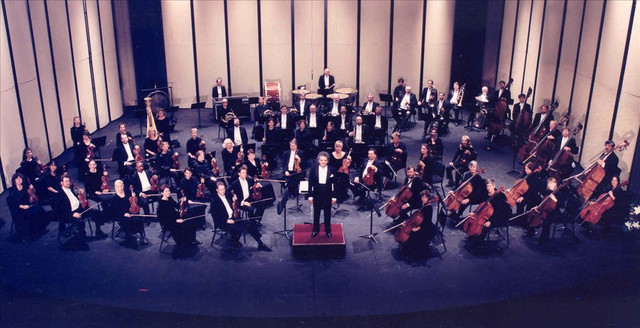
American orchestra is not a single, rigid style but a expansive tradition—the body of orchestral music forged in the United States and performed by its great ensembles. It spans romantic roots, modern experiments, and contemporary minimalism, all while weaving in folk, jazz, and popular elements that give it a distinctive American articulation. For enthusiasts, it’s a living panorama of sound, structure, and national identity.
Origins and birth
The American orchestra took shape in the 19th century, when European immigrant musicians and American composers began to organize programs that could rival European prestige. The New York Philharmonic, founded in 1842, is often cited as the oldest enduring example, with a mission to bring large-scale orchestral works to American audiences. Following it, major regional ensembles formed—the Boston Symphony Orchestra in 1881, the Chicago Symphony Orchestra in 1891, and later Cleveland (1918) and Los Angeles (1919). These orchestras built concert life across cities, funded by patrons, civic pride, and an expanding middle class, and they became the engines of a distinctly American repertoire.
A distinctly American sound emerged in the early to mid-20th century. Aaron Copland became its most influential voice, shaping what many hear as the “American sound”: open orchestral textures, wide-spaced harmonies, and rhythms rooted in folk and vernacular music. Works like Appalachian Spring (1944) and the orchestral suite Rodeo fused concert music with rural and Western imagery, while Fanfare for the Common Man (1942) projected a civic grandeur that felt both national and universal. Copland’s voice found an ideal home in the orchestral concert hall and in the broader broadcast era, helping to canonize an era of American orchestral identity.
Golden age, institutions, and ambassadors
From the 1930s through the 1950s, American orchestras flourished in what many critics call a Golden Age. Radio and, later, television expanded audiences; composers and conductors were commissioned to write ambitious symphonic and orchestral works. Serge Koussevitzky’s Koussevitzky Music Foundation at Tanglewood fostered new scores by Copland, Barber, Ives, and others, turning the American orchestra into a workshop for innovation as well as tradition. Leonard Bernstein emerged as a charismatic ambassador—conductor, composer, and public figure who connected orchestral music to broader audiences through orchestral concerts and Broadway-adjacent works. Other pivotal figures include Samuel Barber (Adagio for Strings, a quintessential American lament), William Grant Still (the first widely recognized African American symphonic voice), Charles Ives (pioneering experimentalism), and, later, John Adams and Ellen Taaffe Zwilich, who carried American orchestral language into late-20th- and early-21st-century sensibilities.
Where it travels
The core of American orchestral music remains most deeply rooted in the United States, in concert halls from coast to coast. Yet its influence travels widely: Canadian audiences share in Copland’s legacy; European orchestras frequently program American works; and orchestras in Asia, Latin America, and elsewhere perform American scores to global acclaim. In short, the American orchestra is a national art form with an international presence, continually renewing itself while honoring a tradition built around large-scale symmetry, expressive breadth, and a distinctive American voice. For enthusiasts, exploring it means tracing a arc from late-Romantic beginnings through neoclassicism, jazz-inflected idioms, and modernism to contemporary minimalism—always with the orchestra as its expressive engine.
Origins and birth
The American orchestra took shape in the 19th century, when European immigrant musicians and American composers began to organize programs that could rival European prestige. The New York Philharmonic, founded in 1842, is often cited as the oldest enduring example, with a mission to bring large-scale orchestral works to American audiences. Following it, major regional ensembles formed—the Boston Symphony Orchestra in 1881, the Chicago Symphony Orchestra in 1891, and later Cleveland (1918) and Los Angeles (1919). These orchestras built concert life across cities, funded by patrons, civic pride, and an expanding middle class, and they became the engines of a distinctly American repertoire.
A distinctly American sound emerged in the early to mid-20th century. Aaron Copland became its most influential voice, shaping what many hear as the “American sound”: open orchestral textures, wide-spaced harmonies, and rhythms rooted in folk and vernacular music. Works like Appalachian Spring (1944) and the orchestral suite Rodeo fused concert music with rural and Western imagery, while Fanfare for the Common Man (1942) projected a civic grandeur that felt both national and universal. Copland’s voice found an ideal home in the orchestral concert hall and in the broader broadcast era, helping to canonize an era of American orchestral identity.
Golden age, institutions, and ambassadors
From the 1930s through the 1950s, American orchestras flourished in what many critics call a Golden Age. Radio and, later, television expanded audiences; composers and conductors were commissioned to write ambitious symphonic and orchestral works. Serge Koussevitzky’s Koussevitzky Music Foundation at Tanglewood fostered new scores by Copland, Barber, Ives, and others, turning the American orchestra into a workshop for innovation as well as tradition. Leonard Bernstein emerged as a charismatic ambassador—conductor, composer, and public figure who connected orchestral music to broader audiences through orchestral concerts and Broadway-adjacent works. Other pivotal figures include Samuel Barber (Adagio for Strings, a quintessential American lament), William Grant Still (the first widely recognized African American symphonic voice), Charles Ives (pioneering experimentalism), and, later, John Adams and Ellen Taaffe Zwilich, who carried American orchestral language into late-20th- and early-21st-century sensibilities.
Where it travels
The core of American orchestral music remains most deeply rooted in the United States, in concert halls from coast to coast. Yet its influence travels widely: Canadian audiences share in Copland’s legacy; European orchestras frequently program American works; and orchestras in Asia, Latin America, and elsewhere perform American scores to global acclaim. In short, the American orchestra is a national art form with an international presence, continually renewing itself while honoring a tradition built around large-scale symmetry, expressive breadth, and a distinctive American voice. For enthusiasts, exploring it means tracing a arc from late-Romantic beginnings through neoclassicism, jazz-inflected idioms, and modernism to contemporary minimalism—always with the orchestra as its expressive engine.