Genre
string orchestra
Top String orchestra Artists
Showing 15 of 15 artists






About String orchestra
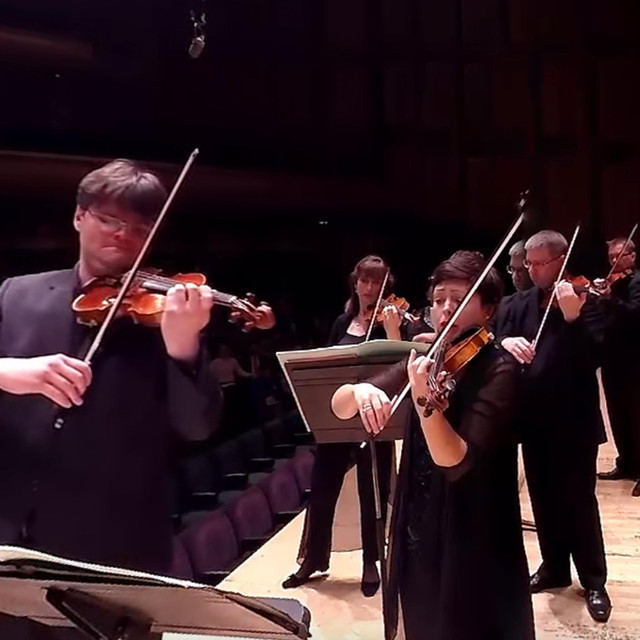
String orchestra is a performing ensemble built entirely from string instruments—violins, violas, cellos, and double basses—with no winds, brass, or percussion. Its sound favors a pure, focused timbre, elegant line, and a blend that can shimmer in tutti passages or whisper in chamber-like dialogue. The repertoire spans from Baroque arrangements to contemporary scores, and the string orchestra remains a fundamental vehicle for both symphonic and intimate concert music.
Origins are gradual. In the 18th century, as public concerts and formal symphonies flowered, composers such as Haydn and Mozart began writing for large string groups within the orchestra and, at times, for standalone string ensembles. The late Baroque and Classical periods saw a rising interest in the string color and contrapuntal possibilities of a full string section. By the 19th century, the string palette had grown more flexible, allowing composers to create music where the entire architecture rests on string textures alone.
Key works and figures. Haydn and Mozart laid the groundwork for string-oriented writing within the symphonic idiom. In the 20th century, Benjamin Britten expanded the language of the string orchestra with Simple Symphony (1934) and other works that exploit vivid color and transparent textures. Gustav Holst’s St Paul Suite (1912) is a landmark for strings, and contemporary composers such as Arvo Pärt, with Cantus in memoriam Benjamin Britten, have continued to define the sound world of modern string ensembles. Stravinsky and Shostakovich also contributed masterful string-focused scores, while today composers like John Adams and Philip Glass frequently foray into string-centric textures that bridge classical and contemporary idioms.
Geography and popularity. String orchestras are most at home in Europe and North America, where conservatories and major concert venues sustain large, professional ensembles and active festival scenes. The United Kingdom, Germany, Austria, Russia, and the Nordic nations maintain long-standing traditions of string-oriented repertoire, while the United States hosts a vibrant ecosystem of regional orchestras and university ensembles dedicated to strings. Japan and several East Asian countries have developed strong string-audio traditions as well, with education systems and festivals that emphasize string performance. In many regions, strings serve as the core texture for film scores, modern chamber works, and festival commissions, helping the genre reach diverse audiences.
Performance practice and appeal. The string orchestra excels in clarity and blend: equal exposure for sections, nuanced phrasing, and a capacity for both exuberant climaxes and hushed introspection. Its repertoire invites lush sonorities, precise bowing, idioms, and a sense of collective breathing that makes large-scale works feel intimate. For listeners, it offers a bridge from the Baroque polyphony through Romantic lyricism to present-day minimalism and beyond, all through the universal language of strings. Explore its spectrum, and you will hear the history of Western music unfold in real time, through the glow of strings, the lift of lines, and the quiet power of resonance that only a string orchestra can summon. It remains a living, worldwide voice, continually reinvented yet deeply rooted in tradition. Audiences leave inspired, and performers continually discover new horizons together.
Origins are gradual. In the 18th century, as public concerts and formal symphonies flowered, composers such as Haydn and Mozart began writing for large string groups within the orchestra and, at times, for standalone string ensembles. The late Baroque and Classical periods saw a rising interest in the string color and contrapuntal possibilities of a full string section. By the 19th century, the string palette had grown more flexible, allowing composers to create music where the entire architecture rests on string textures alone.
Key works and figures. Haydn and Mozart laid the groundwork for string-oriented writing within the symphonic idiom. In the 20th century, Benjamin Britten expanded the language of the string orchestra with Simple Symphony (1934) and other works that exploit vivid color and transparent textures. Gustav Holst’s St Paul Suite (1912) is a landmark for strings, and contemporary composers such as Arvo Pärt, with Cantus in memoriam Benjamin Britten, have continued to define the sound world of modern string ensembles. Stravinsky and Shostakovich also contributed masterful string-focused scores, while today composers like John Adams and Philip Glass frequently foray into string-centric textures that bridge classical and contemporary idioms.
Geography and popularity. String orchestras are most at home in Europe and North America, where conservatories and major concert venues sustain large, professional ensembles and active festival scenes. The United Kingdom, Germany, Austria, Russia, and the Nordic nations maintain long-standing traditions of string-oriented repertoire, while the United States hosts a vibrant ecosystem of regional orchestras and university ensembles dedicated to strings. Japan and several East Asian countries have developed strong string-audio traditions as well, with education systems and festivals that emphasize string performance. In many regions, strings serve as the core texture for film scores, modern chamber works, and festival commissions, helping the genre reach diverse audiences.
Performance practice and appeal. The string orchestra excels in clarity and blend: equal exposure for sections, nuanced phrasing, and a capacity for both exuberant climaxes and hushed introspection. Its repertoire invites lush sonorities, precise bowing, idioms, and a sense of collective breathing that makes large-scale works feel intimate. For listeners, it offers a bridge from the Baroque polyphony through Romantic lyricism to present-day minimalism and beyond, all through the universal language of strings. Explore its spectrum, and you will hear the history of Western music unfold in real time, through the glow of strings, the lift of lines, and the quiet power of resonance that only a string orchestra can summon. It remains a living, worldwide voice, continually reinvented yet deeply rooted in tradition. Audiences leave inspired, and performers continually discover new horizons together.