Genre
prepared piano
Top Prepared piano Artists
Showing 10 of 10 artists


About Prepared piano
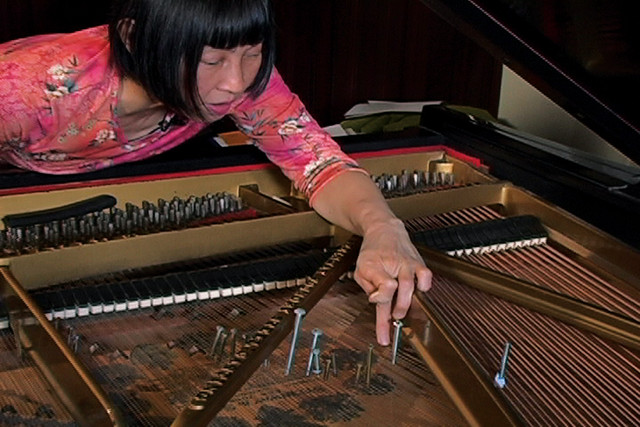
Prepared piano is one of the most inventive extended techniques in 20th‑century music, turning the piano into a flexible percussion and sonic sculpture. Rather than playing only the six standard notes, composers place objects on or between the strings, or inside the body of the instrument, to alter its timbre, attack, sustain, and resonance. The result is a rich palette of sounds: muted, percussive thumps; bright, bell-like tones; metallic scrapes; woody clanks; and even plucked or muted string textures. It’s a stylistic approach rather than a single genre, and it sits at the crossroads of composition, performance, and sound design.
The idea is widely attributed to American composer John Cage, who began experimenting with modifying the piano in the late 1930s and refined the practice in the 1940s. His most influential realization is the set of pieces collectively known as Sonatas and Interludes (composed around 1946–48), written for prepared piano and intended for the interior of the instrument. Cage’s method was to insert a variety of everyday objects—screws, bolts, washers, pieces of rubber, wood, and more—into the strings, thereby creating a new sonic world that could be musically organized, yet often unpredictable. The prepared piano became a central instrument in Cage’s exploration of indeterminacy, chance procedures, and nonstandard timbres.
Key works that solidified the technique include not only Sonatas and Interludes but also Cage’s broader experimental output and the performances by musicians who championed his approach. David Tudor, a pianist and longtime collaborator of Cage, played a pivotal role in bringing the prepared piano to audiences in New York and beyond, staging performances at avant-garde venues and festivals and helping translate Cage’s ideas into living sound. The prepared piano also influenced other composers who adopted the concept or adapted it for their own musical languages. George Crumb, for example, used prepared-piano techniques in the Makrokosmos cycles, expanding the instrument’s sonic range with a few extra notational and performance demands.
Ambassadors of the prepared piano emerged not only from the United States but across Europe as well. In the postwar era, European composers and performers engaged with Cage’s ideas, integrating prepared-piano textures into broader experiments with timbre, audience perception, and the role of chance in music. Today, the technique remains a staple in contemporary classical and experimental circles, studied in conservatories and explored by experimental performers, composers, and sound designers alike. It has influenced not only concert works but also multimedia and installation pieces, where the piano becomes a modular, resonant source, capable of conveying a wide spectrum of emotions and moods.
In terms of geography, the prepared piano is most strongly associated with the United States’ avant-garde scene of the 1950s–70s, with important currents continuing in Europe and Japan among experimentalists who value material, texture, and the subversion of conventional pianistic technique. It endures as a flexible tool for anyone curious about the piano’s hidden sonorities, inviting performers to rethink what a single instrument can say when the ordinary strings are not simply played, but remade.
The idea is widely attributed to American composer John Cage, who began experimenting with modifying the piano in the late 1930s and refined the practice in the 1940s. His most influential realization is the set of pieces collectively known as Sonatas and Interludes (composed around 1946–48), written for prepared piano and intended for the interior of the instrument. Cage’s method was to insert a variety of everyday objects—screws, bolts, washers, pieces of rubber, wood, and more—into the strings, thereby creating a new sonic world that could be musically organized, yet often unpredictable. The prepared piano became a central instrument in Cage’s exploration of indeterminacy, chance procedures, and nonstandard timbres.
Key works that solidified the technique include not only Sonatas and Interludes but also Cage’s broader experimental output and the performances by musicians who championed his approach. David Tudor, a pianist and longtime collaborator of Cage, played a pivotal role in bringing the prepared piano to audiences in New York and beyond, staging performances at avant-garde venues and festivals and helping translate Cage’s ideas into living sound. The prepared piano also influenced other composers who adopted the concept or adapted it for their own musical languages. George Crumb, for example, used prepared-piano techniques in the Makrokosmos cycles, expanding the instrument’s sonic range with a few extra notational and performance demands.
Ambassadors of the prepared piano emerged not only from the United States but across Europe as well. In the postwar era, European composers and performers engaged with Cage’s ideas, integrating prepared-piano textures into broader experiments with timbre, audience perception, and the role of chance in music. Today, the technique remains a staple in contemporary classical and experimental circles, studied in conservatories and explored by experimental performers, composers, and sound designers alike. It has influenced not only concert works but also multimedia and installation pieces, where the piano becomes a modular, resonant source, capable of conveying a wide spectrum of emotions and moods.
In terms of geography, the prepared piano is most strongly associated with the United States’ avant-garde scene of the 1950s–70s, with important currents continuing in Europe and Japan among experimentalists who value material, texture, and the subversion of conventional pianistic technique. It endures as a flexible tool for anyone curious about the piano’s hidden sonorities, inviting performers to rethink what a single instrument can say when the ordinary strings are not simply played, but remade.