Genre
santur
Top Santur Artists
Showing 17 of 17 artists




About Santur
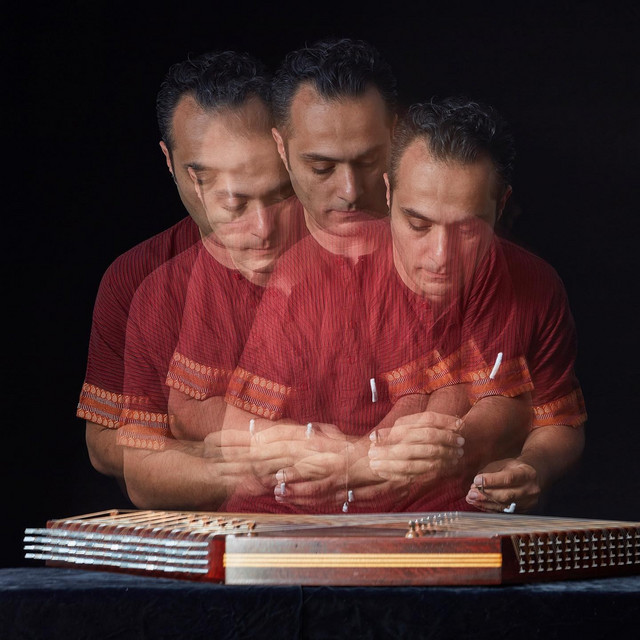
Santar, or santoor in its Kashmiri spelling, is less a single rigid style than a listening civilization built around the hammered dulcimer. Think of a trapezoidal box of strings struck with soft mallets, its shimmering overtones weaving between melody, rhythm, and drone. The genre emerges from a cross-cultural lineage: the Persian santur, the Indian/Kashmiri santoor, and adjacent Central Asian lute-tinged traditions have traded ideas for centuries, giving santar its characteristic bright, reflective sonority and a repertoire that spans classical, folk, and contemporary sound experiments.
Historically, the instrument’s ancestry lies with the hammered dulcimer family that traveled the Silk Road. The Persian santur, with roots deep in medieval court music, set the template: a tessellated array of strings tuned to modal scales and played with lightweight hammers. In Kashmir, the tradition merged with local melodic sensibilities, producing the santoor as a beloved voice in north Indian classical and folk contexts. What makes santar a “genre” rather than a mere instrument is the way composers and performers have pushed its timbre and technique into new musical territories—toward raga-based improvisation, cross-cultural fusions, and cinematic versatility.
A pivotal chapter in santar’s story is the late 20th century, when virtuosos elevated the instrument from regional mainstay to an international ambassador of both tradition and innovation. Pandit Shivkumar Sharma, the visionary Kashmiri maestro, reimagined the santoor within Indian classical performance, incorporating established raga structures, taals, and virtuosic phrasing. His approach helped establish santar as a serious voice in concert halls and recording studios alike. In the resulting fusion era, collaborations with other luminaries—most famously the Shankar–Chaurasia–Sharma trio, featuring Ravi Shankar on sitar and Hariprasad Chaurasia on bansuri—brought the instrument into a broader sonic dialogue, culminating in landmark releases such as the celebrated Call of the Valley. Those recordings crystallized the santar’s capacity to converse with Western and Indian classical languages while retaining a distinct, shimmering identity.
Ambassadors of the genre today extend beyond borders. In Iran, the santur (the Persian form) remains a central voice in classical محسوب music, with virtuosos such as Dariush Talai keeping a high technical and expressive standard. In Afghanistan, Pakistan, and the wider Persianate world, contemporary players continue to explore immigrant and diasporic fusions, layering traditional melodies with jazz, flamenco, or ambient textures. In Europe and North America, santar-based ensembles and solo artists contribute to world-music ecosystems, film scores, and experimental projects, sustaining the genre’s exploratory spirit.
Listening to santar means hearing a sound that is at once intimate and expansive: the malleted attack, the quick tremolo of sympathetic strings, the airy resonance of the wooden body, and the way the instrument sits between melody and mood. It invites meditative depth as easily as it supports intricate rhythmic conversations. For enthusiasts, santar offers a map of cross-cultural dialogue—an instrument-turned-genre that travels, evolves, and continually reveals new tonal horizons.
Historically, the instrument’s ancestry lies with the hammered dulcimer family that traveled the Silk Road. The Persian santur, with roots deep in medieval court music, set the template: a tessellated array of strings tuned to modal scales and played with lightweight hammers. In Kashmir, the tradition merged with local melodic sensibilities, producing the santoor as a beloved voice in north Indian classical and folk contexts. What makes santar a “genre” rather than a mere instrument is the way composers and performers have pushed its timbre and technique into new musical territories—toward raga-based improvisation, cross-cultural fusions, and cinematic versatility.
A pivotal chapter in santar’s story is the late 20th century, when virtuosos elevated the instrument from regional mainstay to an international ambassador of both tradition and innovation. Pandit Shivkumar Sharma, the visionary Kashmiri maestro, reimagined the santoor within Indian classical performance, incorporating established raga structures, taals, and virtuosic phrasing. His approach helped establish santar as a serious voice in concert halls and recording studios alike. In the resulting fusion era, collaborations with other luminaries—most famously the Shankar–Chaurasia–Sharma trio, featuring Ravi Shankar on sitar and Hariprasad Chaurasia on bansuri—brought the instrument into a broader sonic dialogue, culminating in landmark releases such as the celebrated Call of the Valley. Those recordings crystallized the santar’s capacity to converse with Western and Indian classical languages while retaining a distinct, shimmering identity.
Ambassadors of the genre today extend beyond borders. In Iran, the santur (the Persian form) remains a central voice in classical محسوب music, with virtuosos such as Dariush Talai keeping a high technical and expressive standard. In Afghanistan, Pakistan, and the wider Persianate world, contemporary players continue to explore immigrant and diasporic fusions, layering traditional melodies with jazz, flamenco, or ambient textures. In Europe and North America, santar-based ensembles and solo artists contribute to world-music ecosystems, film scores, and experimental projects, sustaining the genre’s exploratory spirit.
Listening to santar means hearing a sound that is at once intimate and expansive: the malleted attack, the quick tremolo of sympathetic strings, the airy resonance of the wooden body, and the way the instrument sits between melody and mood. It invites meditative depth as easily as it supports intricate rhythmic conversations. For enthusiasts, santar offers a map of cross-cultural dialogue—an instrument-turned-genre that travels, evolves, and continually reveals new tonal horizons.