Data may be outdated
Last updated: 9 months ago — Click refresh to get the latest statistics.
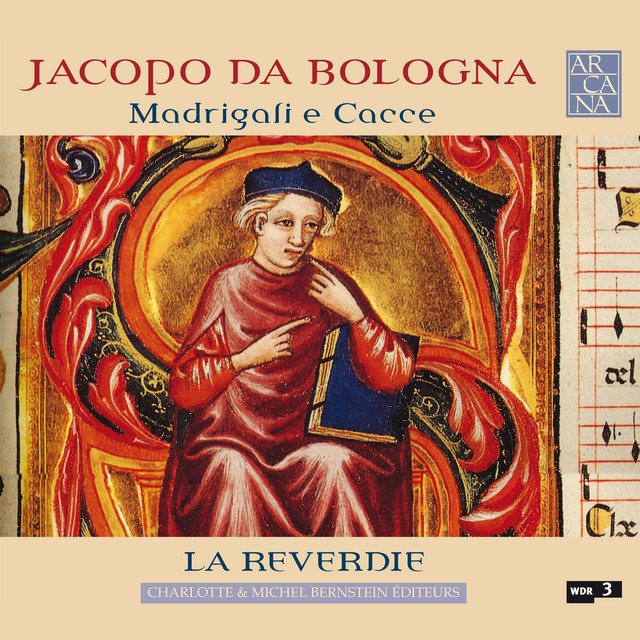
An Italian composer and theorist, Jacopo da Bologna exerted a profound influence on the major figures of fourteenth century Italian music (known as Trecento music). Thirty-four vocal compositions can be securely attributed to him, including the earliest-known three-part, non-canonic Italian madrigals. His madrigal Non al suo amante is the only extant musical setting of a poem by the great Petrarch (1304-1374) by a contemporary. Jacopo is also the author of a treatise on mensural notation in the French manner, L'arte del biscanto misurato secondo el maestro Jacopo da Bologna.
Although he held important positions in powerful courts, no biographical documents have survived. Only the barest information can be gleaned from references to living persons and events in his songs. He was apparently employed by the Visconti family of Milan from 1339 to 1360, save for a brief period spent at the court of Mastino II della Scala in Verona, around 1350. He left no traces after 1360, although the court of Aragon in Spain employed a dancing master of the same name between 1378 and 1386.
The texts of Jacopo's songs depict courtly matters and events. Several of his contemporaries, primarily Giovanni da Cascia and Piero, wrote songs with near-identical subject matter (composers were apparently competing with each other for courtly favors!). The copious references to living persons found therein establishes a fairly reliable chronology of Jacopo's works.
Jacopo composed at a time when polyphonic techniques were in their infancy. His musical settings show a clear stylistic evolution over the years, indicating a conscious effort to develop and refine his craft. The early madrigals, mostly in two parts, are characteristic of "primitive" polyphony: quasi-improvisational writing containing many perfect consonances over a plodding tenor, mostly in long notes. The three-part writing from this period is rudimentary at best, with two upper voices in parallel motion above the tenor. The polyphony of his later works shows much greater control and sophistication. The voices are more balanced and independent, motivically related through improved imitative techniques. More attention is paid, too, to the overall shape of the piece, with carefully worked-out formal divisions which underline the text.
Manuscript evidence indicates that his works were widely circulated in northern Italy and Tuscany, and highly regarded long after his death. His ideal of melodic suavity, his refined artistry, and theoretical scholarship were immensely influential throughout the fourteenth century.
Although he held important positions in powerful courts, no biographical documents have survived. Only the barest information can be gleaned from references to living persons and events in his songs. He was apparently employed by the Visconti family of Milan from 1339 to 1360, save for a brief period spent at the court of Mastino II della Scala in Verona, around 1350. He left no traces after 1360, although the court of Aragon in Spain employed a dancing master of the same name between 1378 and 1386.
The texts of Jacopo's songs depict courtly matters and events. Several of his contemporaries, primarily Giovanni da Cascia and Piero, wrote songs with near-identical subject matter (composers were apparently competing with each other for courtly favors!). The copious references to living persons found therein establishes a fairly reliable chronology of Jacopo's works.
Jacopo composed at a time when polyphonic techniques were in their infancy. His musical settings show a clear stylistic evolution over the years, indicating a conscious effort to develop and refine his craft. The early madrigals, mostly in two parts, are characteristic of "primitive" polyphony: quasi-improvisational writing containing many perfect consonances over a plodding tenor, mostly in long notes. The three-part writing from this period is rudimentary at best, with two upper voices in parallel motion above the tenor. The polyphony of his later works shows much greater control and sophistication. The voices are more balanced and independent, motivically related through improved imitative techniques. More attention is paid, too, to the overall shape of the piece, with carefully worked-out formal divisions which underline the text.
Manuscript evidence indicates that his works were widely circulated in northern Italy and Tuscany, and highly regarded long after his death. His ideal of melodic suavity, his refined artistry, and theoretical scholarship were immensely influential throughout the fourteenth century.
Monthly Listeners
2,531
Monthly Listeners History
Track the evolution of monthly listeners over the last 28 days.
Followers
1,758
Followers History
Track the evolution of followers over the last 28 days.
Top Cities
47 listeners

35 listeners

34 listeners

29 listeners

25 listeners

Related Artists
Paolo da Firenze
Gaucelm Faidit
Arnold de Lantins

Marco Ferrari
Alla Francesca
Gherardello da Firenze
Thibaut de Champagne

Oswald von Wolkenstein
Johannes Ciconia


Cantilena Antiqua
Gace Brulé
Ars Antiqua de Paris
Gautier De Coincy
Claudia Caffagni
Donato da Cascia
Stefano Albarello
Emmanuel Bonnardot

Ensemble Chominciamento di gioia
Jacob de Senleches
Micrologus
Solage
Giovanni da Firenze
Alta Musica
Leonel Power
Trefoil
Baptiste Romain
Michael Fields
Doron David Sherwin