Data may be outdated
Last updated: 7 months ago — Click refresh to get the latest statistics.
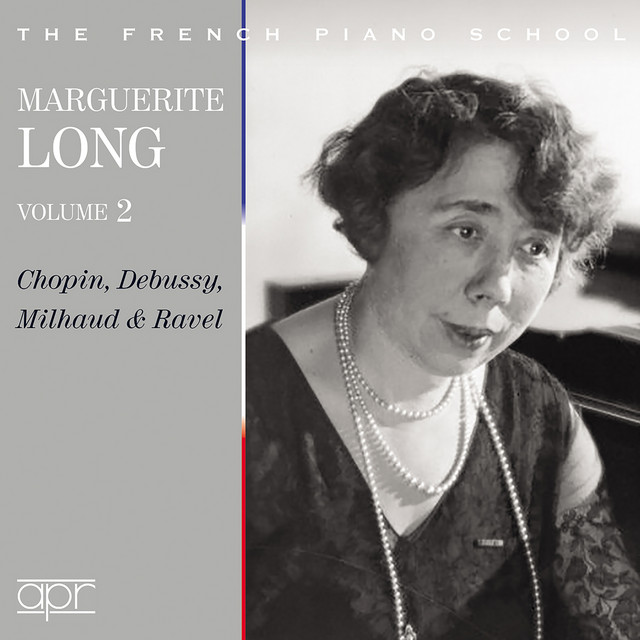
Marguerite Long began her journey to fame as France's foremost woman pianist during the first half of the twentieth century while still a child, taught initially by her sister. Formal training began at the Nimes Conservatory, then the Paris Conservatoire, in 1888, as a pupil of Antonin Marmontel, whose father Antoine had taught <a href="spotify:artist:2D7RkvtKKb6E5UmbjQM1Jd">Bizet</a>, <a href="spotify:artist:74t2IgTigmFhqMn5gs5XPt">d'Indy</a>, Guiraud, <a href="spotify:artist:7JdmVrOYE5cHmR34DGRT2U">Théodore Dubois</a>, and <a href="spotify:artist:1Uff91EOsvd99rtAupatMP">Debussy</a>. In 1889, even before completing her course of study, Long won first prize and immediately started building an international career as soloist and teacher. In 1906, a year after <a href="spotify:artist:2gClsBep1tt1rv1CN210SO">Fauré</a> was named director of the Conservatoire, he put Long in charge of preparatory classes. She had championed his piano works, claiming in fact to be their leading interpreter, but the demand that he appoint her caused a rift, to the extent that <a href="spotify:artist:2gClsBep1tt1rv1CN210SO">Fauré</a> before his death in 1924 called her "a shameless woman who uses my name to get on." Nevertheless, in 1920 he appointed her to succeed Louis Diémer as piano professor -- a position she kept until 1940. Her notable pupils included Jeanne-Marie Darré and Jacques Février. In 1920, she also opened her own studio, independent of the Conservatoire.
To Long's credit, she continued playing <a href="spotify:artist:2gClsBep1tt1rv1CN210SO">Fauré</a>'s music and recording it, even when younger composers became more famous than the old master. In 1914 (the year her husband, Joseph de Marliave, died in action on the Western Front) and again, in 1917, she cornered <a href="spotify:artist:1Uff91EOsvd99rtAupatMP">Debussy</a> for advice about playing his music. In May 1917, he wrote to Roland-Manuel, praising the success of two Études she had introduced: "Mme. Long's fingers seemed to have multiplied and you owe her an enthusiastic encore." But <a href="spotify:artist:1Uff91EOsvd99rtAupatMP">Debussy</a> could not avoid her on July vacation at Saint Jean-deLuz, where "there are a lot of famous pianists in the area . . .including R. Viñes, J. Nin, Mme. M. Long, etc." She was already being perceived as "a jealous and pushy woman who tried to 'adopt' composers for her own benefit." During this same period she cultivated <a href="spotify:artist:17hR0sYHpx7VYTMRfFUOmY">Ravel</a>, who dedicated a movement to Marliave in the keyboard original of Le tombeau de Couperin, which Long premiered in 1919.
In 1932, <a href="spotify:artist:17hR0sYHpx7VYTMRfFUOmY">Ravel</a> asked her to introduce the Piano Concerto in G, belatedly written for the <a href="spotify:artist:0K23lQ2hSQAlxSEeZ05bjI">Boston Symphony</a>'s golden jubilee. He started planning it in 1929 as a vehicle for himself, but the Left-Hand Concerto for <a href="spotify:artist:1UqS69eQIiwDLxXHle0LFK">Paul Wittgenstein</a> took precedence. By the time <a href="spotify:artist:17hR0sYHpx7VYTMRfFUOmY">Ravel</a> finished Concerto in G, the mysterious brain disease that eventually killed him in 1938 had already disabled his technique. He did conduct the premiere at Paris on January 14, 1932, and within a three-month period 20 more performances throughout Europe that exhausted him. When the Concerto was recorded in April 1932, despite <a href="spotify:artist:17hR0sYHpx7VYTMRfFUOmY">Ravel</a>'s name on the label, the conductor was a young Portuguese, Pedro de Frietas-Branco, although the composer supervised "ruthlessly" according to Long. She also introduced the Left-Hand Concerto to Paris, when <a href="spotify:artist:17hR0sYHpx7VYTMRfFUOmY">Ravel</a> rejected changes that <a href="spotify:artist:1UqS69eQIiwDLxXHle0LFK">Wittgenstein</a> had made in the solo part.
With violinist <a href="spotify:artist:00jpyseJZ9ydn4yhiZjt6A">Jacques Thibaud</a>, Long formed a duo in 1940. Three years later, they founded an international competition for violinists and pianists that is still being hed. After Thibaud's death in a 1953 air crash, Long continued to record as well as concertize, including another <a href="spotify:artist:17hR0sYHpx7VYTMRfFUOmY">Ravel</a> G major in 1952 with Georges Tzipine conducting. Her disc repertory included accompanied works by <a href="spotify:artist:2gClsBep1tt1rv1CN210SO">Fauré</a>, <a href="spotify:artist:6bwXuNL4AuC7w3AxspKXn6">Milhaud</a>, and <a href="spotify:artist:2haoq62QRffBi42wBW8hWn">Ernesto Halffter</a> in addition to <a href="spotify:artist:17hR0sYHpx7VYTMRfFUOmY">Ravel</a>'s concertos and Beethoven's "Emperor." Long continued teaching until 1960 (her last pupil was <a href="spotify:artist:0B6EDCUCofaPuEwcJda88X">Bruno Leonardo Gelber</a>). Three of her books were published posthumously: At the Piano with Fauré, with Debussy, and with Ravel, anecdotal as well as instructional.
To Long's credit, she continued playing <a href="spotify:artist:2gClsBep1tt1rv1CN210SO">Fauré</a>'s music and recording it, even when younger composers became more famous than the old master. In 1914 (the year her husband, Joseph de Marliave, died in action on the Western Front) and again, in 1917, she cornered <a href="spotify:artist:1Uff91EOsvd99rtAupatMP">Debussy</a> for advice about playing his music. In May 1917, he wrote to Roland-Manuel, praising the success of two Études she had introduced: "Mme. Long's fingers seemed to have multiplied and you owe her an enthusiastic encore." But <a href="spotify:artist:1Uff91EOsvd99rtAupatMP">Debussy</a> could not avoid her on July vacation at Saint Jean-deLuz, where "there are a lot of famous pianists in the area . . .including R. Viñes, J. Nin, Mme. M. Long, etc." She was already being perceived as "a jealous and pushy woman who tried to 'adopt' composers for her own benefit." During this same period she cultivated <a href="spotify:artist:17hR0sYHpx7VYTMRfFUOmY">Ravel</a>, who dedicated a movement to Marliave in the keyboard original of Le tombeau de Couperin, which Long premiered in 1919.
In 1932, <a href="spotify:artist:17hR0sYHpx7VYTMRfFUOmY">Ravel</a> asked her to introduce the Piano Concerto in G, belatedly written for the <a href="spotify:artist:0K23lQ2hSQAlxSEeZ05bjI">Boston Symphony</a>'s golden jubilee. He started planning it in 1929 as a vehicle for himself, but the Left-Hand Concerto for <a href="spotify:artist:1UqS69eQIiwDLxXHle0LFK">Paul Wittgenstein</a> took precedence. By the time <a href="spotify:artist:17hR0sYHpx7VYTMRfFUOmY">Ravel</a> finished Concerto in G, the mysterious brain disease that eventually killed him in 1938 had already disabled his technique. He did conduct the premiere at Paris on January 14, 1932, and within a three-month period 20 more performances throughout Europe that exhausted him. When the Concerto was recorded in April 1932, despite <a href="spotify:artist:17hR0sYHpx7VYTMRfFUOmY">Ravel</a>'s name on the label, the conductor was a young Portuguese, Pedro de Frietas-Branco, although the composer supervised "ruthlessly" according to Long. She also introduced the Left-Hand Concerto to Paris, when <a href="spotify:artist:17hR0sYHpx7VYTMRfFUOmY">Ravel</a> rejected changes that <a href="spotify:artist:1UqS69eQIiwDLxXHle0LFK">Wittgenstein</a> had made in the solo part.
With violinist <a href="spotify:artist:00jpyseJZ9ydn4yhiZjt6A">Jacques Thibaud</a>, Long formed a duo in 1940. Three years later, they founded an international competition for violinists and pianists that is still being hed. After Thibaud's death in a 1953 air crash, Long continued to record as well as concertize, including another <a href="spotify:artist:17hR0sYHpx7VYTMRfFUOmY">Ravel</a> G major in 1952 with Georges Tzipine conducting. Her disc repertory included accompanied works by <a href="spotify:artist:2gClsBep1tt1rv1CN210SO">Fauré</a>, <a href="spotify:artist:6bwXuNL4AuC7w3AxspKXn6">Milhaud</a>, and <a href="spotify:artist:2haoq62QRffBi42wBW8hWn">Ernesto Halffter</a> in addition to <a href="spotify:artist:17hR0sYHpx7VYTMRfFUOmY">Ravel</a>'s concertos and Beethoven's "Emperor." Long continued teaching until 1960 (her last pupil was <a href="spotify:artist:0B6EDCUCofaPuEwcJda88X">Bruno Leonardo Gelber</a>). Three of her books were published posthumously: At the Piano with Fauré, with Debussy, and with Ravel, anecdotal as well as instructional.



Related Artists
Elie Coff

Harriet Cohen

Simon Barere

Eric James
Issay Dobrowen
Philadelphia Robin Hood Dell Orchestra
Santiago Rodriguez

Ludomir Rózycki
Sergey Sergeyevich Prokoviev
Isidore Philipp

Robert Leonardy
Jeffrey Swann
Vladimir Krainev

Paolo Marzocchi
Aleksandr Konstantinovich Glazunov

Roberto Cappello
Ainslee Cox

Amiram Rigai

Benedikt Koehlen
