Data may be outdated
Last updated: 9 months ago — Click refresh to get the latest statistics.
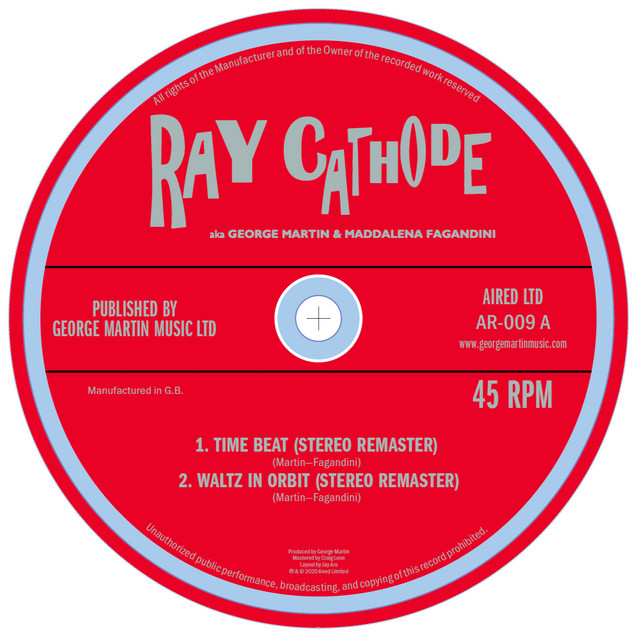
In early 1962, venerated producer, composer, and music executive George Martin collaborated with BBC Radiophonic Workshop’s Maddalena Fagandini to create and record two pioneering electronic instrumental tracks, “Time Beat” and “Waltz in Orbit.” Under the artist pseudonym Ray Cathode, the tracks were released in April 1962 as a Parlophone single and B-side, just weeks before Martin met and recorded The Beatles for the first time.
During his storied seven-decade career, George Martin actively nurtured his lifelong fascination with sound. From his first hit recordings, he would experiment in the studio, using the room and its equipment, playing with different tape speeds, acoustics, reverse echo, backward recording, music concrète, and other forward-looking techniques. Martin’s working base since 1950, EMI’s Abbey Road Studios, was light on electronics at the time, but only a short walk away from the innovative BBC Radiophonic Workshop. There he met fellow audio experimentalists who were making soundscapes for television shows from nascent electronic hardware they'd made or acquired long before the emergence of anything recognizable as similar. At the Workshop, every sound was made laboriously by hand. The Ray Cathode tracks heralded the dawn of electronica.
Martin and Fagandini’s pioneering use of synths on “Time Beat” is carried forward in the song’s 2020 Drum & Lace remix, using some of today’s innovative recording technology.
During his storied seven-decade career, George Martin actively nurtured his lifelong fascination with sound. From his first hit recordings, he would experiment in the studio, using the room and its equipment, playing with different tape speeds, acoustics, reverse echo, backward recording, music concrète, and other forward-looking techniques. Martin’s working base since 1950, EMI’s Abbey Road Studios, was light on electronics at the time, but only a short walk away from the innovative BBC Radiophonic Workshop. There he met fellow audio experimentalists who were making soundscapes for television shows from nascent electronic hardware they'd made or acquired long before the emergence of anything recognizable as similar. At the Workshop, every sound was made laboriously by hand. The Ray Cathode tracks heralded the dawn of electronica.
Martin and Fagandini’s pioneering use of synths on “Time Beat” is carried forward in the song’s 2020 Drum & Lace remix, using some of today’s innovative recording technology.
Monthly Listeners
3,919
Monthly Listeners History
Track the evolution of monthly listeners over the last 28 days.
Followers
1,462
Followers History
Track the evolution of followers over the last 28 days.
Top Cities
107 listeners

98 listeners

69 listeners
68 listeners
66 listeners
Related Artists