Data may be outdated
Last updated: 9 months ago — Click refresh to get the latest statistics.
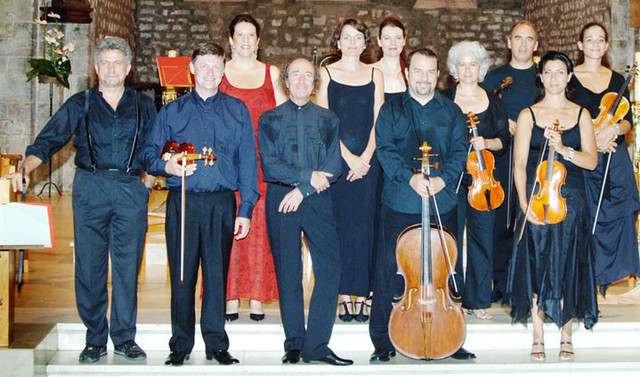
The King's Noyse, the leading, North American, Renaissance-style violin ensemble was founded by David Douglass. Douglass, a faculty member at Aston Magna Academy, teacher at early music institutes, workshops, and festivals, and lecturer on early violin technique, founded the group as an outgrowth of his studies in that field.
Douglass notes that other stringed instruments of the period such as the lute and the various viols are the subjects of treatises and teaching books dating from the Renaissance, but there is little of this nature concerning the violin family. The technique of playing the instrument was passed down from teacher to pupil or from master to apprentice. This, he says, is because the violin, unlike the others, was considered so difficult that it was reserved for professional players only. Violin ensembles, therefore, were too expensive for any but the very wealthy, the higher nobility, and royalty to afford, and were employed to entertain at their courts.
The repertory was mainly dance music, with some consort music for listening or background, and made extensive use of well-known songs and dance tunes. This music was not as regularly stored and cared for as the religious music of the time, which typically was written by the maestro di capella of a given major church and kept in the church archives. The repertory of the King's Noyse is primarily based on dance books that began appearing in print after 1600, of which the publications issued under the title John Playford's Dancing Master is one of the best known titles. Other collections of ballads and tunes from around Europe figure into the repertory, arranged by Douglass in a manner consistent with what is known of the violin technique and dance rhythms of the time, and follow the example of the scholarship of David Hart, a pioneer of early dance music on Baroque flute and other music.
In addition, the King's Noyse plays in a manner almost certainly followed by Renaissance fiddlers, playing from memory or improvising on standardized bass lines such as those of the passamezzi. This is very similar to the jamming of today's jazz or country groups playing upon the bass, rhythm, and harmonic changes of a standard tune, without a page of sheet music to be seen. The group is known for its enthusiastic performances at festivals and concerts throughout the U.S., Canada, and Europe. Douglass has taken the King's Noyse to various venues including the Berkeley Early Music Festival, the Utrecht Festival, and the Boston Festival of Early Music. It is frequently joined by <a href="spotify:artist:3IaOjT4uvherNQzpFMKiEu">Andrew Lawrence-King</a> of the <a href="spotify:artist:3CEB3ot8CDIWKFzBRJvJ4n">Harp Consort</a> and lutenist <a href="spotify:artist:50x7umX0AIHNXkSwumHPRg">Paul O'Dette</a> for concerts and workshop appearances.
Douglass notes that other stringed instruments of the period such as the lute and the various viols are the subjects of treatises and teaching books dating from the Renaissance, but there is little of this nature concerning the violin family. The technique of playing the instrument was passed down from teacher to pupil or from master to apprentice. This, he says, is because the violin, unlike the others, was considered so difficult that it was reserved for professional players only. Violin ensembles, therefore, were too expensive for any but the very wealthy, the higher nobility, and royalty to afford, and were employed to entertain at their courts.
The repertory was mainly dance music, with some consort music for listening or background, and made extensive use of well-known songs and dance tunes. This music was not as regularly stored and cared for as the religious music of the time, which typically was written by the maestro di capella of a given major church and kept in the church archives. The repertory of the King's Noyse is primarily based on dance books that began appearing in print after 1600, of which the publications issued under the title John Playford's Dancing Master is one of the best known titles. Other collections of ballads and tunes from around Europe figure into the repertory, arranged by Douglass in a manner consistent with what is known of the violin technique and dance rhythms of the time, and follow the example of the scholarship of David Hart, a pioneer of early dance music on Baroque flute and other music.
In addition, the King's Noyse plays in a manner almost certainly followed by Renaissance fiddlers, playing from memory or improvising on standardized bass lines such as those of the passamezzi. This is very similar to the jamming of today's jazz or country groups playing upon the bass, rhythm, and harmonic changes of a standard tune, without a page of sheet music to be seen. The group is known for its enthusiastic performances at festivals and concerts throughout the U.S., Canada, and Europe. Douglass has taken the King's Noyse to various venues including the Berkeley Early Music Festival, the Utrecht Festival, and the Boston Festival of Early Music. It is frequently joined by <a href="spotify:artist:3IaOjT4uvherNQzpFMKiEu">Andrew Lawrence-King</a> of the <a href="spotify:artist:3CEB3ot8CDIWKFzBRJvJ4n">Harp Consort</a> and lutenist <a href="spotify:artist:50x7umX0AIHNXkSwumHPRg">Paul O'Dette</a> for concerts and workshop appearances.
Monthly Listeners
3,870
Monthly Listeners History
Track the evolution of monthly listeners over the last 28 days.
Followers
3,034
Followers History
Track the evolution of followers over the last 28 days.
Top Cities



Related Artists

Musica Antiqua of London
Pierre Phalèse

Christian Mendoze
Musica Antiqua
Giorgio Mainerio
Pierre Phalèse the Elder

Peter Pontvik

Pietro Busca

Ensemble Villancico
Ludwig Senfl

Syntagma Musicum
Pierre Francisque Caroubel
Orazio Vecchi
Salomone Rossi
The Harp Consort
Michel Praetorius
Hayne van Ghizeghem

Eustache du Caurroy

The Toronto Consort
Bettina Hoffmann

Les Sacqueboutiers

Henry Tudor
Praetorius Consort

Vincenzo Ruffo
Pietro Paolo Borrono

Lucas Ruiz de Ribayaz
Anonymous
Jacques Moderne