Data may be outdated
Last updated: 9 months ago — Click refresh to get the latest statistics.
The Majority might be best remembered, or indeed primarily known, for recording a couple of songs penned by writers from much bigger groups that didn't release their own versions. Of the many British Invasion-era bands that never had a hit, however, the Majority had more staying power than most, releasing eight singles on Decca between 1965 and 1968. They never quite found a consistent stylistic direction or great material, however, before changing their name to Majority One in the late '60s.
Formed in Hull, England, as the Mustangs in the early '60s, they changed their name to the Majority around the time they moved to London in 1965. With more of an American pop/rock vocal harmony style than most British Invasion groups, they tried their hand at a variety of material over the next few years, most of it coming from outside songwriters. As a minor coup of sorts, for their second single, 1965's "A Little Bit of Sunlight," they managed to gain access to a <a href="spotify:artist:6spXkXEP6teMn2cu9sWbBR">Ray Davies</a> composition that never found a place on a 1960s <a href="spotify:artist:1SQRv42e4PjEYfPhS0Tk9E">Kinks</a> record (though a 1965 demo <a href="spotify:artist:6spXkXEP6teMn2cu9sWbBR">Davies</a> cut with session men eventually found release). They also covered another <a href="spotify:artist:6spXkXEP6teMn2cu9sWbBR">Davies</a> song, <a href="spotify:artist:1SQRv42e4PjEYfPhS0Tk9E">the Kinks</a>' "Ring the Bells," on the B-side of their next single, though to be honest the Majority versions of both songs were not in the same league as the <a href="spotify:artist:6spXkXEP6teMn2cu9sWbBR">Davies</a>-sung ones.
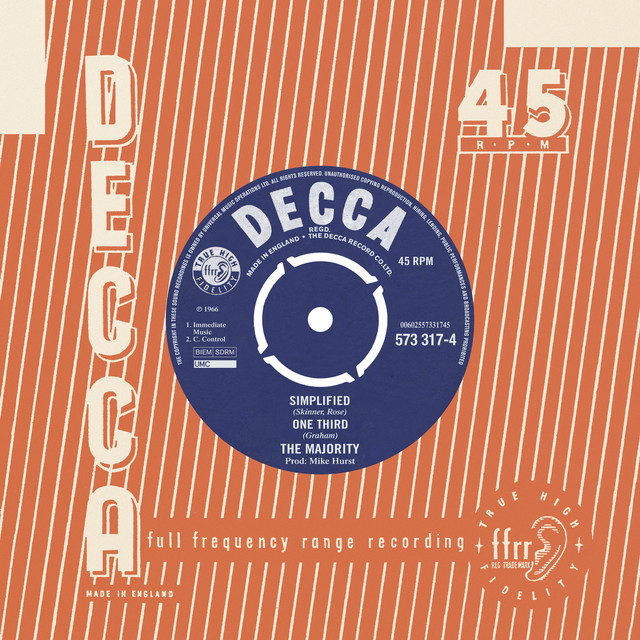
In search of chart material, the Majority also tried compositions written or co-written by such luminaries as <a href="spotify:artist:29bSP1G67IixkZAv6VhlaT">John Carter</a>, <a href="spotify:artist:3e7COBNViJzuMezPocuEpO">Twice as Much</a>, and <a href="spotify:artist:4J9k7L7BrJ7NMWAcvgox1B">Chip Taylor</a>. But they never hit a commercial or artistic gold mine, the production varying from the lush to straightforward mod-ish rock. One such effort in the latter vein, "One Third" (which like several of their better recordings faintly recalled <a href="spotify:artist:2jgPkn6LuUazBoBk6vvjh5">the Zombies</a>), did find a bigger audience decades later when it was included on the Nuggets, Vol. 2 box set of overlooked '60s British Invasion/early psychedelic-like rock from non-U.S. countries. Lead singer Barry Graham wrote "One Third," but his contributions to the group's recorded repertoire were limited to a couple B-sides.
The Majority's eighth and final single, "All Our Christmases," would generate another collectible for future British '60s rock aficionados to hunt down in subsequent decades, as it was written but not recorded by <a href="spotify:artist:1LZEQNv7sE11VDY3SdxQeN">the Bee Gees</a>. After some major lineup shuffles and work backing singer <a href="spotify:artist:5JJxBX97vBHW7KMsBqIJre">Barry Ryan</a> in concert and in the studio, the Majority relocated to France, where they renamed themselves Majority One in 1969 and continued their recording career with a similar but more sophisticated musical approach. All of the tracks from the Majority's singles except one are on the CD compilation The Decca Years 1965-68. ~ Richie Unterberger, Rovi
Formed in Hull, England, as the Mustangs in the early '60s, they changed their name to the Majority around the time they moved to London in 1965. With more of an American pop/rock vocal harmony style than most British Invasion groups, they tried their hand at a variety of material over the next few years, most of it coming from outside songwriters. As a minor coup of sorts, for their second single, 1965's "A Little Bit of Sunlight," they managed to gain access to a <a href="spotify:artist:6spXkXEP6teMn2cu9sWbBR">Ray Davies</a> composition that never found a place on a 1960s <a href="spotify:artist:1SQRv42e4PjEYfPhS0Tk9E">Kinks</a> record (though a 1965 demo <a href="spotify:artist:6spXkXEP6teMn2cu9sWbBR">Davies</a> cut with session men eventually found release). They also covered another <a href="spotify:artist:6spXkXEP6teMn2cu9sWbBR">Davies</a> song, <a href="spotify:artist:1SQRv42e4PjEYfPhS0Tk9E">the Kinks</a>' "Ring the Bells," on the B-side of their next single, though to be honest the Majority versions of both songs were not in the same league as the <a href="spotify:artist:6spXkXEP6teMn2cu9sWbBR">Davies</a>-sung ones.
In search of chart material, the Majority also tried compositions written or co-written by such luminaries as <a href="spotify:artist:29bSP1G67IixkZAv6VhlaT">John Carter</a>, <a href="spotify:artist:3e7COBNViJzuMezPocuEpO">Twice as Much</a>, and <a href="spotify:artist:4J9k7L7BrJ7NMWAcvgox1B">Chip Taylor</a>. But they never hit a commercial or artistic gold mine, the production varying from the lush to straightforward mod-ish rock. One such effort in the latter vein, "One Third" (which like several of their better recordings faintly recalled <a href="spotify:artist:2jgPkn6LuUazBoBk6vvjh5">the Zombies</a>), did find a bigger audience decades later when it was included on the Nuggets, Vol. 2 box set of overlooked '60s British Invasion/early psychedelic-like rock from non-U.S. countries. Lead singer Barry Graham wrote "One Third," but his contributions to the group's recorded repertoire were limited to a couple B-sides.
The Majority's eighth and final single, "All Our Christmases," would generate another collectible for future British '60s rock aficionados to hunt down in subsequent decades, as it was written but not recorded by <a href="spotify:artist:1LZEQNv7sE11VDY3SdxQeN">the Bee Gees</a>. After some major lineup shuffles and work backing singer <a href="spotify:artist:5JJxBX97vBHW7KMsBqIJre">Barry Ryan</a> in concert and in the studio, the Majority relocated to France, where they renamed themselves Majority One in 1969 and continued their recording career with a similar but more sophisticated musical approach. All of the tracks from the Majority's singles except one are on the CD compilation The Decca Years 1965-68. ~ Richie Unterberger, Rovi
Monthly Listeners
306
Monthly Listeners History
Track the evolution of monthly listeners over the last 28 days.
Followers
187
Followers History
Track the evolution of followers over the last 28 days.
Top Cities
10 listeners

9 listeners

6 listeners
4 listeners
4 listeners
Related Artists

Outer Limits


Timon


The New Wing
Tony & Terri
The Truth