Genre
bhangra
Top Bhangra Artists
Showing 25 of 3,081 artists
About Bhangra
Bhangra is a high-energy fusion of Punjab’s traditional folk rhythms with contemporary club sensibilities, a music genre and dance form that has traveled from farmers’ fields to global stages and streaming playlists. Rooted in the Punjab region of South Asia, it blossomed as a harvest celebration powered by the dhol, a barrel-shaped drum whose booming bass and snapping treble drive the groove. The vocal lines carry Punjabi storytelling, often sung in call-and-response with the chorus, while melodic hooks and rhythmic handclaps keep the tempo infectious. Over time, bhangra absorbed pop, hip-hop, reggae, and electronic textures, expanding its vocabulary without losing its exuberant core.
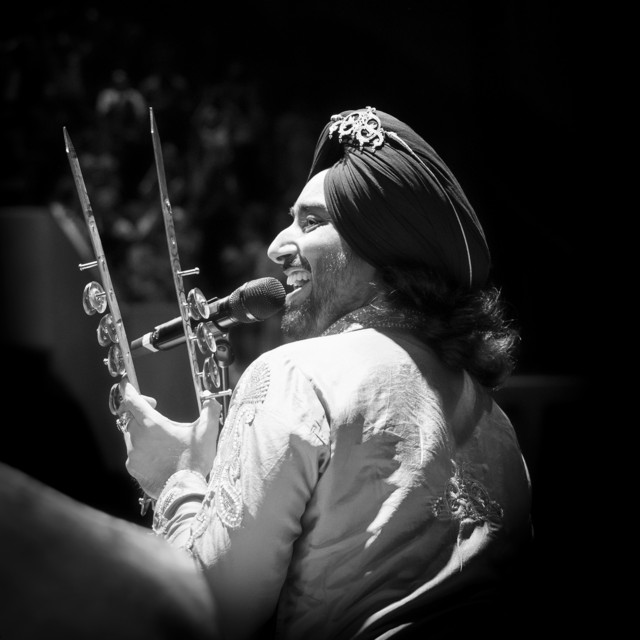
Historically, bhangra originated as a rural folk tradition tied to Vaisakhi, the spring harvest festival, and weddings. Its early iterations were performed by men in the fields or at festive gatherings, accompanied by instruments like the dhol, tumbi (a high-pitched plucked instrument), chimta (metal tongs that click in the rhythm), and dholki. As Punjab’s music scene matured in the mid-20th century, bhangra began to evolve beyond strictly folk formats. The 1960s through the 1980s saw a flowering of Punjabi pop and film music, setting the stage for a modern bhangra that could travel beyond villages and border fences. Then came the diaspora explosion in the United Kingdom and North America, where migrants preserved the sound while innovating it with Western production, language shifts, and new dance floor energy.
In its contemporary form, bhangra remains instantly recognizable for its dhol-driven heartbeat, brisk tempos, and anthemic vocal refrains. Producers layer rich synths, sampled loops, and Western bass with traditional patterns, creating a sound that can feel both celebratory and club-ready. The genre’s versatility has birthed substyles and fusions—bhait, bhangra-pop, bhangra-house, and cross-genre collaborations with hip-hop, dancehall, and EDM—allowing bhangra to sit comfortably on festival stages, chart hits, and underground nights alike. The emphasis on rhythm and dance makes bhangra as much a social experience as a sonic one, inviting listeners to clap, stamp, and move.
Key artists and ambassadors have helped spread bhangra globally. Panjabi MC popularized the global cross-pollination in the late 1990s with Mundian To Bach Ke, a track that fused bhangra energy with hip-hop and a James Bond riff, sparking dance floors worldwide. Daler Mehndi became a household name in the pop-bhangra explosion of the late 1990s with Tunak Tunak Tun and a string of upbeat anthems that crossed language boundaries. Gurdas Maan and Malkit Singh anchored bhangra’s credibility in its peak Punjabi-pop years, while Bally Sagoo helped shape the remix culture that allowed bhangra to travel through the UK and beyond. Apache Indian and Abrar-ul-Haq also broadened the genre’s horizons by blending bhangra with reggae, pop, and socially conscious lyrics.
Today, bhangra is most popular in the Punjab region (India and Pakistan) and in the Punjabi diaspora across the United Kingdom, Canada, the United States, and Australia. Cities with large Punjabi communities—Birmingham, London, Vancouver, Toronto, Brampton, and California’s Golden Triangle—serve as creative hubs, studios, and live stages where the sound continuously reinvents itself. For music enthusiasts, bhangra offers a vibrant bridge between tradition and modernity: a rhythmic pledge to dance, memory, and global connection.
Historically, bhangra originated as a rural folk tradition tied to Vaisakhi, the spring harvest festival, and weddings. Its early iterations were performed by men in the fields or at festive gatherings, accompanied by instruments like the dhol, tumbi (a high-pitched plucked instrument), chimta (metal tongs that click in the rhythm), and dholki. As Punjab’s music scene matured in the mid-20th century, bhangra began to evolve beyond strictly folk formats. The 1960s through the 1980s saw a flowering of Punjabi pop and film music, setting the stage for a modern bhangra that could travel beyond villages and border fences. Then came the diaspora explosion in the United Kingdom and North America, where migrants preserved the sound while innovating it with Western production, language shifts, and new dance floor energy.
In its contemporary form, bhangra remains instantly recognizable for its dhol-driven heartbeat, brisk tempos, and anthemic vocal refrains. Producers layer rich synths, sampled loops, and Western bass with traditional patterns, creating a sound that can feel both celebratory and club-ready. The genre’s versatility has birthed substyles and fusions—bhait, bhangra-pop, bhangra-house, and cross-genre collaborations with hip-hop, dancehall, and EDM—allowing bhangra to sit comfortably on festival stages, chart hits, and underground nights alike. The emphasis on rhythm and dance makes bhangra as much a social experience as a sonic one, inviting listeners to clap, stamp, and move.
Key artists and ambassadors have helped spread bhangra globally. Panjabi MC popularized the global cross-pollination in the late 1990s with Mundian To Bach Ke, a track that fused bhangra energy with hip-hop and a James Bond riff, sparking dance floors worldwide. Daler Mehndi became a household name in the pop-bhangra explosion of the late 1990s with Tunak Tunak Tun and a string of upbeat anthems that crossed language boundaries. Gurdas Maan and Malkit Singh anchored bhangra’s credibility in its peak Punjabi-pop years, while Bally Sagoo helped shape the remix culture that allowed bhangra to travel through the UK and beyond. Apache Indian and Abrar-ul-Haq also broadened the genre’s horizons by blending bhangra with reggae, pop, and socially conscious lyrics.
Today, bhangra is most popular in the Punjab region (India and Pakistan) and in the Punjabi diaspora across the United Kingdom, Canada, the United States, and Australia. Cities with large Punjabi communities—Birmingham, London, Vancouver, Toronto, Brampton, and California’s Golden Triangle—serve as creative hubs, studios, and live stages where the sound continuously reinvents itself. For music enthusiasts, bhangra offers a vibrant bridge between tradition and modernity: a rhythmic pledge to dance, memory, and global connection.