Data may be outdated
Last updated: 9 months ago — Click refresh to get the latest statistics.
Agostino Steffani was an important Italian composer of vocal music from the late seventeenth and early eighteenth centuries. His chamber duets, operas (generally written in the bel canto style), and sacred works constitute his finest efforts. Steffani was born in Castelfranco, near Venice, on July 25, 1654. He served as a choirboy at the Basilica of St. Anthony in Padua from 1664-1667 under maestro di cappella Antonio dalla Tavola, who likely gave him instruction in music. By age 11 Steffani was regularly appearing in operas and concerts, and a year later was taken to Munich at the behest of the Elector Ferdinand Maria of Bavaria.
Young Steffani sang in operas and in church services there while receiving excellent musical education under the guidance of the maestro di cappella of the Elector's Court, <a href="spotify:artist:6C7WpXdNnhvYe6flgvL68i">Johann Kaspar Kerll</a>. By age 14 Steffani was taking organ lessons from <a href="spotify:artist:6C7WpXdNnhvYe6flgvL68i">Kerll</a>, but rarely appearing as a singer anymore.
In 1672 he traveled to Rome to study composition with Ercole Bernabei. During his nearly two-year stay there, Steffani produced Psalmodia vespertina, a collection of Psalm settings, and a Magnificat. Shortly after Steffani's return to Munich in 1674 he was appointed court organist.
In 1680 he was ordained a priest and a year later appointed court director of chamber music by the new Elector Maximilian II Emanuel, whose father Ferdinand Maria died in 1679. Steffani would also take on duties as a diplomat with neighboring courts. In composition he remained quite active, too: having written his first opera Marco Aurelio in 1677, he composed his next four, which included Servio Tullio in the period 1685-1688, all premiered at the busy Munich Court.
Steffani left Munich in 1688 to work at the Hanover Court, where he spent 15 years as kapellmeister and diplomat. He composed several successful operas during his tenure there, including Orlando generoso (1691).
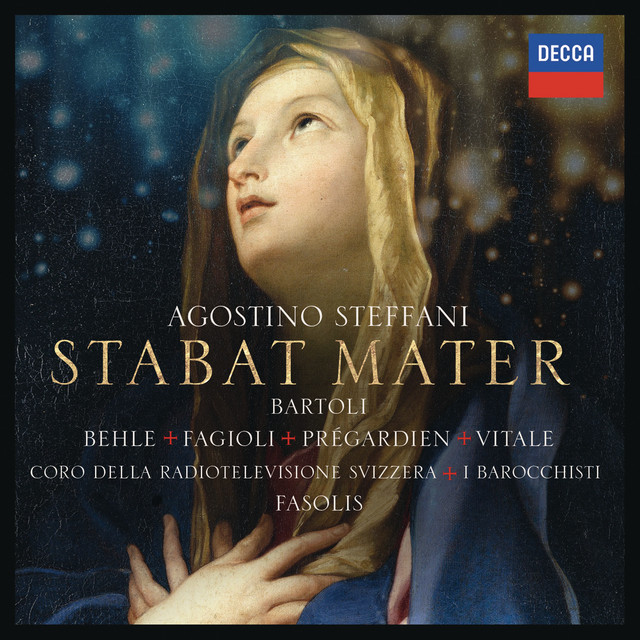
In 1702-1703 he produced a fine collection of chamber duets at Hanover, after which he accepted a post at the Düsseldorf Court of Johann Wilhelm, Elector Palatine. Thereafter Steffani composed very little. He was elected Bishop of Spiga in 1706 and apostolic vicar for Northern Germany three years later. He focused most of his energies on church matters in his later years, though he did manage to write a few works, including the Stabat Mater (1727-1728), his favorite composition. He died in 1728 of apoplexy.
Young Steffani sang in operas and in church services there while receiving excellent musical education under the guidance of the maestro di cappella of the Elector's Court, <a href="spotify:artist:6C7WpXdNnhvYe6flgvL68i">Johann Kaspar Kerll</a>. By age 14 Steffani was taking organ lessons from <a href="spotify:artist:6C7WpXdNnhvYe6flgvL68i">Kerll</a>, but rarely appearing as a singer anymore.
In 1672 he traveled to Rome to study composition with Ercole Bernabei. During his nearly two-year stay there, Steffani produced Psalmodia vespertina, a collection of Psalm settings, and a Magnificat. Shortly after Steffani's return to Munich in 1674 he was appointed court organist.
In 1680 he was ordained a priest and a year later appointed court director of chamber music by the new Elector Maximilian II Emanuel, whose father Ferdinand Maria died in 1679. Steffani would also take on duties as a diplomat with neighboring courts. In composition he remained quite active, too: having written his first opera Marco Aurelio in 1677, he composed his next four, which included Servio Tullio in the period 1685-1688, all premiered at the busy Munich Court.
Steffani left Munich in 1688 to work at the Hanover Court, where he spent 15 years as kapellmeister and diplomat. He composed several successful operas during his tenure there, including Orlando generoso (1691).
In 1702-1703 he produced a fine collection of chamber duets at Hanover, after which he accepted a post at the Düsseldorf Court of Johann Wilhelm, Elector Palatine. Thereafter Steffani composed very little. He was elected Bishop of Spiga in 1706 and apostolic vicar for Northern Germany three years later. He focused most of his energies on church matters in his later years, though he did manage to write a few works, including the Stabat Mater (1727-1728), his favorite composition. He died in 1728 of apoplexy.
Monthly Listeners
6,525
Monthly Listeners History
Track the evolution of monthly listeners over the last 28 days.
Followers
2,795
Followers History
Track the evolution of followers over the last 28 days.
Top Cities
180 listeners

120 listeners
113 listeners

100 listeners

89 listeners

Related Artists

Il Seminario Musicale
Delphine Galou

Céline Scheen
Gemma Bertagnolli

Giovanni Legrenzi

La Nuova Musica
Francesco Gasparini
Luigi Rossi
John Blow
Geminiano Giacomelli

David Bates
Carlotta Colombo

Michelangelo Falvetti
Luigi Rossi
André Campra


Nereydas

David Hansen
José de Nebra


Jean-Paul Fouchécourt
Jean Gilles
Francesco Durante

Emiliano Gonzalez Toro
La Risonanza
