Data may be outdated
Last updated: 9 months ago — Click refresh to get the latest statistics.
By 1975, <a href="spotify:artist:4y0Cb1j7NWmbzt8P8p8TBb">Rupert Hine</a> was already beginning to gain credibility as a producer and session musician, but he had also released two of that era's most cryptic solo albums in Pick Up a Bone and Unfinished Picture. The latter in particular demonstrated that <a href="spotify:artist:4y0Cb1j7NWmbzt8P8p8TBb">Hine</a> had few peers when it came to shaping elaborate instrumental textures and atmospheres without departing from a song-based format. Most listeners' overriding feeling on hearing them, however, was one of perplexity, and sales were correspondingly minuscule. But throughout his career, <a href="spotify:artist:4y0Cb1j7NWmbzt8P8p8TBb">Hine</a> has shown himself perfectly willing to rein in his more experimental tendencies for the sake of shifting a few more units. In the '80s, for instance, he largely subsumed the complexities of his three solo albums for Island beneath the hard and shiny surface of his faux band, <a href="spotify:artist:7bAhMY1eSnJh04TU0MEJnH">Thinkman</a>. And that's pretty much what he did in 1975 when he formed Quantum Jump, which is not to say that the band represented a blatant bid for chart success -- far from it. But in stark contrast to the somewhat austere Unfinished Picture, Quantum Jump's first album wasn't afraid to get funky.
The band formed after <a href="spotify:artist:4y0Cb1j7NWmbzt8P8p8TBb">Hine</a> became a regular visitor to a countryside studio owned by drummer Trevor Morais. The two became the nucleus of Quantum Jump and were soon joined by bassist <a href="spotify:artist:0bn8bDKUpS581TddwPb6cy">John G. Perry</a>, recently a member of <a href="spotify:artist:5kwbFaRKf9HCFGrJPacZ7s">Caravan</a> and a regular contributor to <a href="spotify:artist:4y0Cb1j7NWmbzt8P8p8TBb">Hine</a>'s solo work and his early productions of albums by <a href="spotify:artist:5k5yIvxtsqHqWrRBF3nhSY">Kevin Ayers</a> and <a href="spotify:artist:2d6JU9LvNhZR7AAtu4x2rS">Yvonne Elliman</a>. Auditions for a guitarist followed, during which <a href="spotify:artist:3rHBApuFwaJy65f7vWQJLr">Andy Summers</a> was among those passed over, but the job eventually went to the Washington, D.C.-born Mark Warner. The final ingredient was provided by lyricist David MacIver, with whom <a href="spotify:artist:4y0Cb1j7NWmbzt8P8p8TBb">Hine</a> had made his first recordings in 1966 as Rupert & David. One song, however ("Starbright Park"), had lyrics by Jeanette Obstoj, marking the beginning of a working relationship that continued long after Quantum Jump's demise, and which would one day find them writing for <a href="spotify:artist:1zuJe6b1roixEKMOtyrEak">Tina Turner</a>.
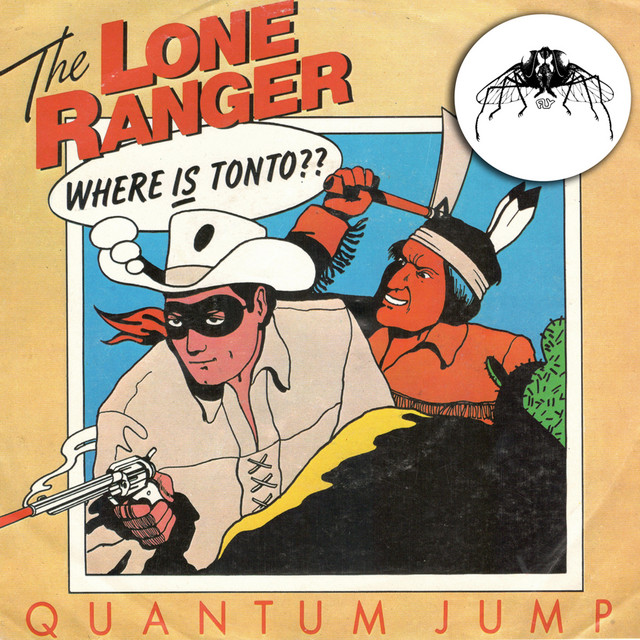
Inspired by Warner's formidable technique and by their love of <a href="spotify:artist:3Ao7NH7lRyQAeKQg2mlTcO">the Mahavishnu Orchestra</a>, the bandmembers wanted to see if it were possible to combine jazz-rock arrangements with a pop sensibility. Things looked promising when their first single -- the untypically whimsical "The Lone Ranger" (which hinted that the Masked Man had a crush on Tonto) -- became a minor hit in the U.K. The album, though, steadfastly refused to follow suit, and for the band's follow-up, Barracuda, a more polished style closer in spirit to progressive rock was adopted. Needless to say, 1976 was not the year to be launching a new prog rock band, and Quantum Jump folded soon after. ~ Christopher Evans, Rovi
The band formed after <a href="spotify:artist:4y0Cb1j7NWmbzt8P8p8TBb">Hine</a> became a regular visitor to a countryside studio owned by drummer Trevor Morais. The two became the nucleus of Quantum Jump and were soon joined by bassist <a href="spotify:artist:0bn8bDKUpS581TddwPb6cy">John G. Perry</a>, recently a member of <a href="spotify:artist:5kwbFaRKf9HCFGrJPacZ7s">Caravan</a> and a regular contributor to <a href="spotify:artist:4y0Cb1j7NWmbzt8P8p8TBb">Hine</a>'s solo work and his early productions of albums by <a href="spotify:artist:5k5yIvxtsqHqWrRBF3nhSY">Kevin Ayers</a> and <a href="spotify:artist:2d6JU9LvNhZR7AAtu4x2rS">Yvonne Elliman</a>. Auditions for a guitarist followed, during which <a href="spotify:artist:3rHBApuFwaJy65f7vWQJLr">Andy Summers</a> was among those passed over, but the job eventually went to the Washington, D.C.-born Mark Warner. The final ingredient was provided by lyricist David MacIver, with whom <a href="spotify:artist:4y0Cb1j7NWmbzt8P8p8TBb">Hine</a> had made his first recordings in 1966 as Rupert & David. One song, however ("Starbright Park"), had lyrics by Jeanette Obstoj, marking the beginning of a working relationship that continued long after Quantum Jump's demise, and which would one day find them writing for <a href="spotify:artist:1zuJe6b1roixEKMOtyrEak">Tina Turner</a>.
Inspired by Warner's formidable technique and by their love of <a href="spotify:artist:3Ao7NH7lRyQAeKQg2mlTcO">the Mahavishnu Orchestra</a>, the bandmembers wanted to see if it were possible to combine jazz-rock arrangements with a pop sensibility. Things looked promising when their first single -- the untypically whimsical "The Lone Ranger" (which hinted that the Masked Man had a crush on Tonto) -- became a minor hit in the U.K. The album, though, steadfastly refused to follow suit, and for the band's follow-up, Barracuda, a more polished style closer in spirit to progressive rock was adopted. Needless to say, 1976 was not the year to be launching a new prog rock band, and Quantum Jump folded soon after. ~ Christopher Evans, Rovi
Monthly Listeners
2,850
Monthly Listeners History
Track the evolution of monthly listeners over the last 28 days.
Followers
1,012
Followers History
Track the evolution of followers over the last 28 days.
Top Cities
312 listeners

112 listeners
78 listeners
63 listeners

61 listeners
Related Artists

The Regents
Fox
YellowDog
Terry Dactyl & The Dinosaurs

Sad Cafe
Family
Metro
Monsoon

The Music Beach

The Milton Hunter Orchestra

Paul Davidson