Data may be outdated
Last updated: 1 month ago — Click refresh to get the latest statistics.
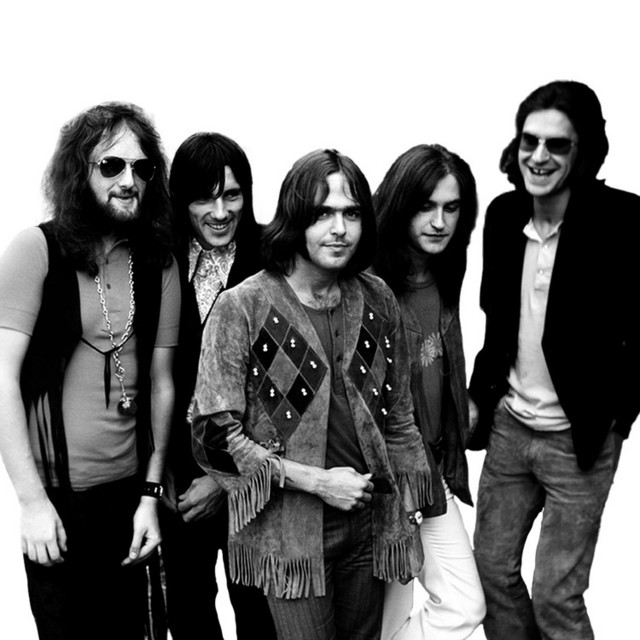
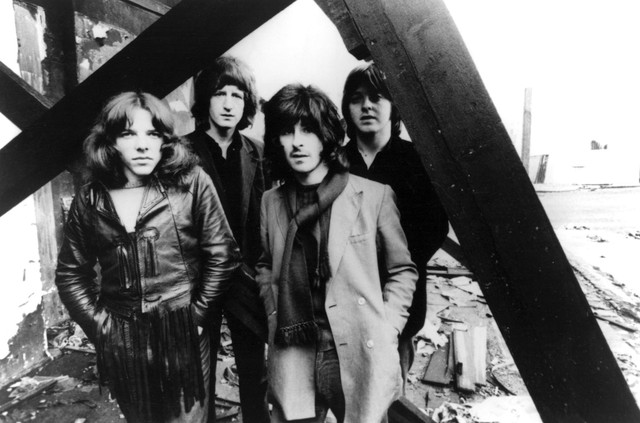
Often described in their early days as a hybrid of <a href="spotify:artist:74ASZWbe4lXaubB36ztrGX">Dylan</a> and <a href="spotify:artist:3WrFJ7ztbogyGnTHbHJFl2">the Beatles</a>, the Byrds in turn influenced <a href="spotify:artist:74ASZWbe4lXaubB36ztrGX">Dylan</a> and <a href="spotify:artist:3WrFJ7ztbogyGnTHbHJFl2">the Beatles</a> almost as much as <a href="spotify:artist:74ASZWbe4lXaubB36ztrGX">Dylan</a> and <a href="spotify:artist:3WrFJ7ztbogyGnTHbHJFl2">the Fab Four</a> had influenced the Byrds. The Byrds' innovations have echoed nearly as strongly through subsequent generations in the work of <a href="spotify:artist:2UZMlIwnkgAEDBsw1Rejkn">Tom Petty</a>, <a href="spotify:artist:4KWTAlx2RvbpseOGMEmROg">R.E.M.</a>, and innumerable alternative bands of the post-punk era that feature those jangling guitars and dense harmonies.
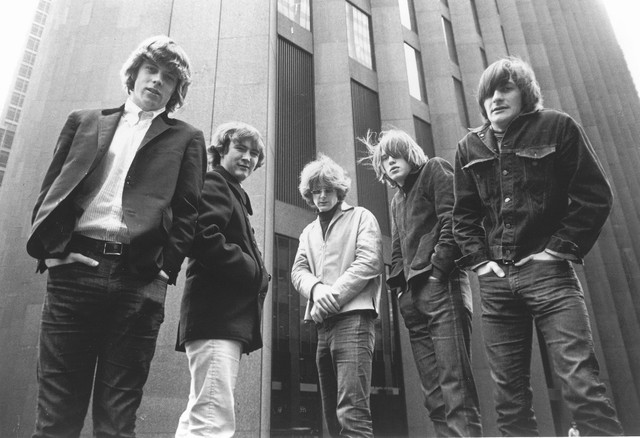
Although the Byrds had perfected their blend of folk and rock when their debut single, "Mr. Tambourine Man," topped the charts in mid-1965, it was something of a miracle that the group had managed to coalesce in the first place. Not a single member of the original quintet had extensive experience on electric instruments. Jim McGuinn (he'd change his first name to <a href="spotify:artist:3ExrAwcOqgGjt9kFRwdM76">Roger</a> a few years later), <a href="spotify:artist:59zdhVoWxSoHMc74n098Re">David Crosby</a>, and <a href="spotify:artist:040Bv6cZTRh30LyyYVXgJX">Gene Clark</a> were all young veterans of both commercial folk-pop troupes and the acoustic coffeehouse scene. They were inspired by the success of <a href="spotify:artist:3WrFJ7ztbogyGnTHbHJFl2">the Beatles</a> to mix folk and rock; <a href="spotify:artist:3ExrAwcOqgGjt9kFRwdM76">McGuinn</a> had already been playing <a href="spotify:artist:3WrFJ7ztbogyGnTHbHJFl2">Beatles</a> songs acoustically in Los Angeles folk clubs when <a href="spotify:artist:040Bv6cZTRh30LyyYVXgJX">Clark</a> approached him to form an act, according to subsequent recollections, in the <a href="spotify:artist:6lHC2EQMEMZiEmSfFloarn">Peter & Gordon</a> style. <a href="spotify:artist:59zdhVoWxSoHMc74n098Re">David Crosby</a> soon joined and they made a primitive demo as the Jet Set that was nonetheless bursting with promise. With the help of session musicians, they released a single on <a href="spotify:search:label%3A%22Elektra%22">Elektra</a> as <a href="spotify:artist:4rplbOIy9spnsuAvVXpqyR">the Beefeaters</a> that, while a flop, showed them getting quite close to the folk-rock sound that would electrify the pop scene in a few months.
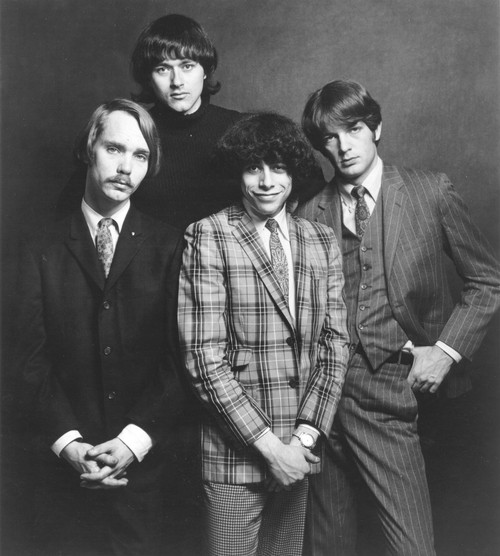
The Beefeaters, soon renamed the Byrds, were fleshed out to a quintet with the addition of drummer <a href="spotify:artist:0XpkZLxjL48PUmLEI9rHYD">Michael Clarke</a> and bluegrass mandolinist <a href="spotify:artist:70FybmH2MMz9fHewhnLvjs">Chris Hillman</a>, who was enlisted to play electric bass, although he had never played the instrument before. The band was so lacking in equipment in their early stages that <a href="spotify:artist:0XpkZLxjL48PUmLEI9rHYD">Clarke</a> played on cardboard boxes during their first rehearsals, but they were determined to master their instruments and become a full-fledged rock band (many demos from this period would later surface for official release). They managed to procure a demo of a new <a href="spotify:artist:74ASZWbe4lXaubB36ztrGX">Dylan</a> song, "Mr. Tambourine Man"; by eliminating some verses and adding instantly memorable 12-string guitar leads and <a href="spotify:artist:3WrFJ7ztbogyGnTHbHJFl2">Beatlesque</a> harmonies, they came up with the first big folk-rock smash (though <a href="spotify:artist:4DQj1q0unpi9KF8jO1Wqks">the Beau Brummels</a> and others had begun exploring similar territory as well). For the "Mr. Tambourine Man" single, the band's vocals and <a href="spotify:artist:3ExrAwcOqgGjt9kFRwdM76">McGuinn</a>'s inimitable Rickenbacker were backed by session musicians, although the band themselves (contrary to some widely circulated rumors) performed on their subsequent recordings.
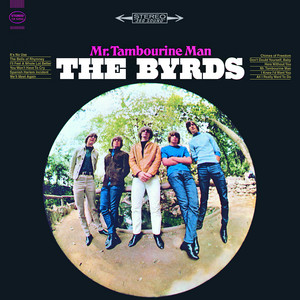
The first long-haired American group to compete with the British Invasion bands visually as well as musically, the Byrds were soon anointed as the American counterpart to <a href="spotify:artist:3WrFJ7ztbogyGnTHbHJFl2">the Beatles</a> by the press, legions of fans, and <a href="spotify:artist:7FIoB5PHdrMZVC3q2HE5MS">George Harrison</a> himself. Their 1965 debut LP, Mr. Tambourine Man, was a fabulous album that mixed stellar interpretations of <a href="spotify:artist:74ASZWbe4lXaubB36ztrGX">Dylan</a> and <a href="spotify:artist:1P9syEkl41IFowWIJN7ZBY">Pete Seeger</a> tunes with strong, more romantic and pop-based originals, usually written by <a href="spotify:artist:040Bv6cZTRh30LyyYVXgJX">Gene Clark</a> in the band's early days. A few months later, their version of <a href="spotify:artist:1P9syEkl41IFowWIJN7ZBY">Seeger</a>'s "Turn! Turn! Turn!" became another number one hit and instant classic, featuring more great chiming guitar lines and ethereal, interweaving harmonies. While their second LP (Turn! Turn! Turn!) wasn't as strong as their debut full-length, the band continued to move forward at a dizzying pace. In early 1966, the "Eight Miles High" single heralded the birth of psychedelia, with its drug-like (intentionally or otherwise) lyrical imagery, rumbling bassline, and a frenzied <a href="spotify:artist:3ExrAwcOqgGjt9kFRwdM76">McGuinn</a> guitar solo that took its inspiration from <a href="spotify:artist:2hGh5VOeeqimQFxqXvfCUf">John Coltrane</a> and Indian music.
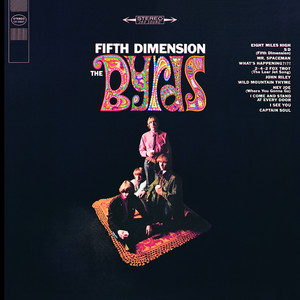
The Byrds suffered a major loss right after "Eight Miles High" with the departure of <a href="spotify:artist:040Bv6cZTRh30LyyYVXgJX">Gene Clark</a>, their primary songwriter and, along with <a href="spotify:artist:3ExrAwcOqgGjt9kFRwdM76">McGuinn</a>, their chief lead vocalist. The reason for his resignation, ironically, was fear of flying, although other pressures were at work as well. Unbelievably, "Eight Miles High" would be their last Top 20 single; many radio stations banned the record for its alleged drug references, halting its progress at number 14. This ended the Byrds' brief period as commercial challengers to <a href="spotify:artist:3WrFJ7ztbogyGnTHbHJFl2">the Beatles</a>, but they regrouped impressively in the face of the setbacks. With the band continuing as a quartet, <a href="spotify:artist:3ExrAwcOqgGjt9kFRwdM76">McGuinn</a>, <a href="spotify:artist:59zdhVoWxSoHMc74n098Re">Crosby</a>, and <a href="spotify:artist:70FybmH2MMz9fHewhnLvjs">Hillman</a> would assume a much larger (actually, the entire) chunk of the songwriting responsibilities. Their third album, Fifth Dimension, contained more groundbreaking folk-rock and psychedelia on tracks like "Fifth Dimension," "I See You," and "John Riley," although it (like several of their classic early albums) mixed sheer brilliance with tracks that were oddly half-baked or carelessly executed.
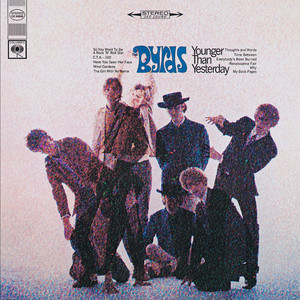
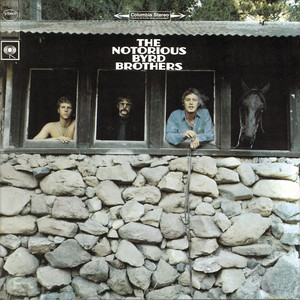
Younger Than Yesterday, (1967) which included the small hits "So You Want to Be a Rock 'n' Roll Star" and "My Back Pages" (another <a href="spotify:artist:74ASZWbe4lXaubB36ztrGX">Dylan</a> cover), was another high point, <a href="spotify:artist:70FybmH2MMz9fHewhnLvjs">Hillman</a> and <a href="spotify:artist:59zdhVoWxSoHMc74n098Re">Crosby</a> in particular taking their writing to a new level. In 1967, <a href="spotify:artist:59zdhVoWxSoHMc74n098Re">Crosby</a> would assert a much more prominent role in the band, singing and writing some of his best material. He wasn't getting along so well with <a href="spotify:artist:3ExrAwcOqgGjt9kFRwdM76">McGuinn</a> and <a href="spotify:artist:70FybmH2MMz9fHewhnLvjs">Hillman</a>, though, and was jettisoned from the Byrds partway into the recording of The Notorious Byrd Brothers. <a href="spotify:artist:040Bv6cZTRh30LyyYVXgJX">Gene Clark</a>, drafted back into the band as a replacement, left after only a few weeks, and by the end of 1967, <a href="spotify:artist:0XpkZLxjL48PUmLEI9rHYD">Michael Clarke</a> was also gone. Remarkably, in the midst of this chaos (not to mention diminishing record sales), they continued to sound as good as ever on Notorious. This was another effort that mixed electronic experimentation and folk-rock mastery with aplomb, with hints of a growing interest in country music.
As <a href="spotify:artist:3ExrAwcOqgGjt9kFRwdM76">McGuinn</a> and <a href="spotify:artist:70FybmH2MMz9fHewhnLvjs">Hillman</a> rebuilt the group one more time in early 1968, <a href="spotify:artist:3ExrAwcOqgGjt9kFRwdM76">McGuinn</a> mused about the exciting possibility of a double album that would play as nothing less than a history of contemporary music, evolving from traditional folk and country to jazz and electronic sounds. Toward this end, he hired <a href="spotify:artist:1KA3WXYMPLxomNuoE22LYd">Gram Parsons</a>, he has since said, to play keyboards. Under <a href="spotify:artist:1KA3WXYMPLxomNuoE22LYd">Parsons</a>' influence, however, the Byrds were soon going full blast into country music, with <a href="spotify:artist:1KA3WXYMPLxomNuoE22LYd">Parsons</a> taking a large share of the guitar and vocal chores. In 1968, <a href="spotify:artist:3ExrAwcOqgGjt9kFRwdM76">McGuinn</a>, <a href="spotify:artist:70FybmH2MMz9fHewhnLvjs">Hillman</a>, <a href="spotify:artist:1KA3WXYMPLxomNuoE22LYd">Parsons</a>, and drummer Kevin Kelly recorded Sweetheart of the Rodeo, which was probably the first album to be widely labeled as country-rock.
Opinions as to the merits of Rodeo remain sharply divided among Byrds fans. Some see it as a natural continuation of the group's innovations; other bemoan the loss of the band's trademark crystalline guitar jangle and the short-circuited potential of <a href="spotify:artist:3ExrAwcOqgGjt9kFRwdM76">McGuinn</a>'s most ambitious experiments. However one feels, there's no doubt that it marked the end, or at least a drastic revamping, of the "classic" Byrds sound of the 1965-1968 period (bookended by the Tambourine Man and Notorious albums). <a href="spotify:artist:1KA3WXYMPLxomNuoE22LYd">Parsons</a>, the main catalyst for the metamorphosis, left the band after about six months, partially in objection to a 1968 Byrds tour of South Africa. It couldn't have helped, though, that <a href="spotify:artist:3ExrAwcOqgGjt9kFRwdM76">McGuinn</a> replaced several of <a href="spotify:artist:1KA3WXYMPLxomNuoE22LYd">Parsons</a>' lead vocals on Rodeo with his own at the last minute, ostensibly due to contractual obstacles that prevented <a href="spotify:artist:1KA3WXYMPLxomNuoE22LYd">Parsons</a> from singing on <a href="spotify:search:label%3A%22Columbia%22">Columbia</a> releases. (Some tracks with <a href="spotify:artist:1KA3WXYMPLxomNuoE22LYd">Parsons</a>' lead vocals showed up anyway, and a few others surfaced in the '90s on the Byrds box set).
<a href="spotify:artist:70FybmH2MMz9fHewhnLvjs">Chris Hillman</a> left the Byrds by the end of 1968 to form <a href="spotify:artist:0rESpKEusFHxhW59MIf7eM">the Flying Burrito Brothers</a> with <a href="spotify:artist:1KA3WXYMPLxomNuoE22LYd">Parsons</a>. Although <a href="spotify:artist:3ExrAwcOqgGjt9kFRwdM76">McGuinn</a> kept the Byrds going for about another five years with other musicians (most notably former country picker <a href="spotify:artist:6bV5tUO90I3oRIy3Gy1UOG">Clarence White</a>), essentially, the Byrds' name was a front for <a href="spotify:artist:3ExrAwcOqgGjt9kFRwdM76">Roger McGuinn</a> and backing band. Opinions, again, remain sharply divided about the merits of latter-day Byrds albums. <a href="spotify:artist:3ExrAwcOqgGjt9kFRwdM76">McGuinn</a> was such an idiosyncratic and pleasurable talent that fans and critics are inclined to give him some slack; no one else plays the 12-string as well, he's a fine arranger, and his <a href="spotify:artist:4x1nvY2FN8jxqAFA0DA02H">Lennon</a>-meets-<a href="spotify:artist:74ASZWbe4lXaubB36ztrGX">Dylan</a> vocals are immediately distinctive. Yet aside from some good echoes of vintage Byrds like "Chestnut Mare," "Jesus Is Just Alright," and "Drug Store Truck Drivin' Man," nothing from the post-1968 Byrds albums resonates with nearly the same effervescent quality and authority of their classic 1965-1968 period. This is partly because <a href="spotify:artist:3ExrAwcOqgGjt9kFRwdM76">McGuinn</a> is an erratic (though occasionally fine) songwriter; it's also because the Byrds at their peak were very much a unit of diverse and considerable talents, not just a front for their leader's ideas.
The Byrds' diminishing importance must have stung <a href="spotify:artist:3ExrAwcOqgGjt9kFRwdM76">McGuinn</a> doubly in light of the rising profiles of several Byrds alumni as the '60s turned into the '70s. <a href="spotify:artist:59zdhVoWxSoHMc74n098Re">David Crosby</a> was a superstar with <a href="spotify:artist:2pdvghEHZJtgSXZ7cvNLou">Crosby, Stills, Nash & Young</a>; <a href="spotify:artist:70FybmH2MMz9fHewhnLvjs">Hillman</a>, <a href="spotify:artist:1KA3WXYMPLxomNuoE22LYd">Parsons</a>, and (for a while) <a href="spotify:artist:0XpkZLxjL48PUmLEI9rHYD">Michael Clarke</a> were taking country-rock further with <a href="spotify:artist:0rESpKEusFHxhW59MIf7eM">the Flying Burrito Brothers</a>; even <a href="spotify:artist:040Bv6cZTRh30LyyYVXgJX">Gene Clark</a>, though he'd dropped out of sight commercially, was recording some respectable country-rock albums on his own. The original quintet actually got back together for a one-off reunion album in 1973; though it made the Top 20, it was the first, and one of the most flagrant, examples of the futility of a great band reuniting in an attempt to recapture the lightning one last time.
The original Byrds continued to pursue solo careers and outside projects throughout the '70s and '80s. <a href="spotify:artist:3ExrAwcOqgGjt9kFRwdM76">McGuinn</a>, <a href="spotify:artist:040Bv6cZTRh30LyyYVXgJX">Clark</a>, and <a href="spotify:artist:70FybmH2MMz9fHewhnLvjs">Hillman</a> had some success at the end of the '70s with an adult contemporary variation on the Byrds' sound; in the '80s, <a href="spotify:artist:59zdhVoWxSoHMc74n098Re">Crosby</a> battled drug problems while <a href="spotify:artist:70FybmH2MMz9fHewhnLvjs">Hillman</a> enjoyed mainstream country success with <a href="spotify:artist:19FK6WGl1TLyFNsXXqTz8u">the Desert Rose Band</a>. The Byrds' legend was tarnished by squabbles over which members of the original lineup had the rights to use the Byrds name; for quite a while, drummer <a href="spotify:artist:0XpkZLxjL48PUmLEI9rHYD">Michael Clarke</a> even toured with as "Byrds" that featured no other original members. The Byrds were inducted into the Rock & Roll Hall of Fame in 1991; <a href="spotify:artist:040Bv6cZTRh30LyyYVXgJX">Gene Clark</a> died several months later, and <a href="spotify:artist:0XpkZLxjL48PUmLEI9rHYD">Michael Clarke</a> died in 1993, permanently scotching prospects of a reunion involving the original quintet. <a href="spotify:artist:59zdhVoWxSoHMc74n098Re">David Crosby</a> died on January 18, 2023 at the age of 81. ~ Richie Unterberger, Rovi
Monthly Listeners
1.3 million
Monthly Listeners History
Track the evolution of monthly listeners over the last 28 days.
Followers
1.1 million
Followers History
Track the evolution of followers over the last 28 days.
Total Streams
795.6 million
Total Streams History
Track the evolution of total streams over the last 28 days. This data is calculated from all tracks listed in the artist's discography.