Data may be outdated
Last updated: 9 months ago — Click refresh to get the latest statistics.
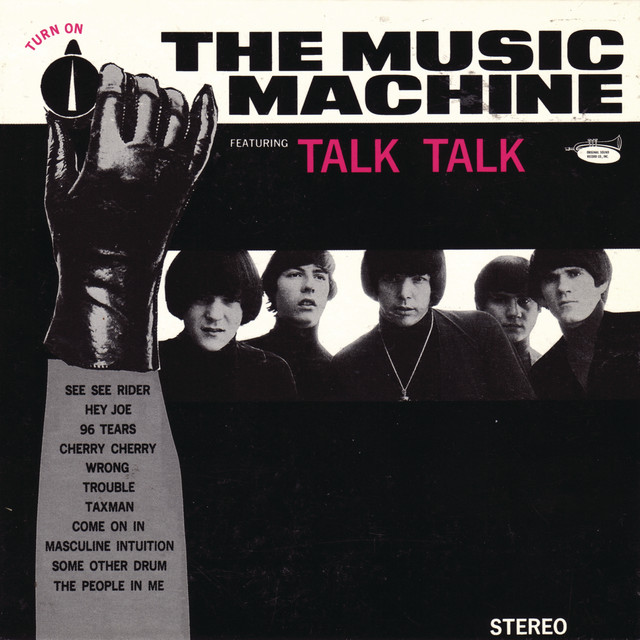
Most famous for "Talk Talk," a Top 20 single from 1966 that was one of the most manic '60s garage-punk hits, the Music Machine had much more depth and songwriting talent than the typical one-hit wonders of the day. Lead singer and songwriter <a href="spotify:artist:1MYDqrtApvd7wwV9HdPVKV">Sean Bonniwell</a>'s strangled lyrics and dark, verbose vision paced the group's wiry psychedelic guitar lines and ominous, minor-key Farfisa organ. The San Jose, California-born <a href="spotify:artist:1MYDqrtApvd7wwV9HdPVKV">Bonniwell</a> had been inspired to form his first group in high school in the late '50s after hearing "Only You" by <a href="spotify:artist:6KWcxMWVNVIYbdOQyJtsSy">the Platters</a>. He later moved into folk music, and was a guitarist with such early-'60s folk outfits as the Noblemen and the Wayfarers (who'd enjoyed a recording contract with RCA Victor). But by the mid-'60s, with the folk revival boom over (along with the Wayfarers Trio, the British Invasion cresting, and folk-rock on the edge of exploding around him) <a href="spotify:artist:1MYDqrtApvd7wwV9HdPVKV">Bonniwell</a> formed the Ragamuffins in tandem with bassist <a href="spotify:artist:5tNV8b1D2iT3dQmSMaX0X2">Keith Olsen</a> and drummer Ron Edgar (late of the folk-pop combo <a href="spotify:artist:2AvTFaVpbDDqCyRtyUZBjs">the Goldebriars</a>). The trio later expanded to a quintet with organist/pianist Doug Rhodes, and second guitarist Mark Landon joining. By 1966, they'd taken on the somewhat more extreme versions of the requisite <a href="spotify:artist:3WrFJ7ztbogyGnTHbHJFl2">Beatles</a> haircut, topping an image dominated by black outfits (and <a href="spotify:artist:1MYDqrtApvd7wwV9HdPVKV">Bonniwell</a>'s trademarked single black leather glove), and renamed themselves far more distinctively as the Music Machine. <a href="spotify:artist:1MYDqrtApvd7wwV9HdPVKV">Bonniwell</a> was the dominant personality in the group, as a songwriter of exceptional ability and also a serious taskmaster; he'd been very serious about his playing, and also about the recording process, coming off of three LPs with the Wayfarers, and in contrast to most of their rivals of the period, pushed the group into many hours of rehearsals. Even more important, he got them to perfect their sound without getting stale in the process, and the playing by all of the members was first-rate; <a href="spotify:artist:1yap1SgRPMxgyfrrDlQ95y">Rhodes</a>' Farfisa organ and <a href="spotify:artist:5tNV8b1D2iT3dQmSMaX0X2">Olsen</a>'s attack on the bass were perfectly matched to <a href="spotify:artist:1MYDqrtApvd7wwV9HdPVKV">Bonniwell</a>'s intense, brooding vocals. The result was a sound -- as demonstrated on their best singles and the best moments of their one and only LP -- that combined an edgy garage punk attack with playing that was studio- and radio-friendly. They were signed up by producer Brian Ross, who got their debut single, "Talk Talk," released on <a href="spotify:search:label%3A%22Original+Sound%22">Original Sound</a>. That record, a piercing one minute-and-fifty-six-second garage-punk explosion released at the end of 1966, made it to number 15 on the charts and propelled the Music Machine to national prominence (including upward of a dozen appearances on American Bandstand, according to <a href="spotify:artist:1MYDqrtApvd7wwV9HdPVKV">Bonniwell</a>). They were never able to follow it up adequately. Only one album was released with the original lineup, and the group's ferocious energy was diluted on subsequent recordings. Despite chalking up only one more minor hit single ("The People in Me"), the Music Machine recorded quite a few excellent, imaginatively produced singles and album tracks that found them exploring the darker side of psychedelia with compelling intensity and imagination. Poor management and some incredibly bad decision-making led to their dissolution at the time, but <a href="spotify:artist:1MYDqrtApvd7wwV9HdPVKV">Bonniwell</a> is still something of a musical legend in the 21st century, and "Talk Talk" is regarded as a garage punk classic. <a href="spotify:artist:5tNV8b1D2iT3dQmSMaX0X2">Keith Olsen</a> subsequently moved into production, and worked in that capacity with <a href="spotify:artist:1yap1SgRPMxgyfrrDlQ95y">Emitt Rhodes</a> and others before striking a multi-platinum vein with the mid-'70s incarnation (or reincarnation) of <a href="spotify:artist:08GQAI4eElDnROBrJRGE0X">Fleetwood Mac</a> on their self-titled 1975 album. Mark Landon seems to have vanished from music after working with <a href="spotify:artist:1MYDqrtApvd7wwV9HdPVKV">Bonniwell</a> and company, but Doug Rhodes and Ron Edgar both moved in and out of the orbit of renowned producer <a href="spotify:artist:3ZMUNnwvFihTTyI1tx5hao">Curt Boettcher</a> (also an ex-member of <a href="spotify:artist:2AvTFaVpbDDqCyRtyUZBjs">the Goldebriars</a>) through groups such as <a href="spotify:artist:2G0qagNyJSe7wZLJCKdfFA">Sagittarius</a> and <a href="spotify:artist:2C49JSiNeHN0xwLQCohpyY">the Millennium</a>, and Edgar also played drums with <a href="spotify:artist:70ZTdbPEcEugBNay4MvxfL">Bread</a> on their self-titled album. ~ Richie Unterberger & Bruce Eder, Rovi
Monthly Listeners
20,513
Monthly Listeners History
Track the evolution of monthly listeners over the last 28 days.
Followers
18,311
Followers History
Track the evolution of followers over the last 28 days.
Top Cities
481 listeners

462 listeners

260 listeners
242 listeners
234 listeners