Data may be outdated
Last updated: 1 month ago — Click refresh to get the latest statistics.
Though American by birth, Callas (born Maria Anne Sofia Cecilia Kalogeropoulos) was born of Greek parents, and at age 13 her mother took her back to Greece because of financial difficulties caused by the Great Depression. She studied voice at the Royal Academy of Music in Athens with Spanish coloratura soprano Elvira de Hidalgo and made rapid progress; she soon sang Santuzza in a student production of Cavalleria rusticana. Her professional debut came at age 16 in a minor role in <a href="spotify:artist:0Yy8ebHB2Ubh1xVIdddNYF">von Suppé</a>'s Boccaccio.
While still in Athens during World War II, Callas sang her first Tosca in 1942. In 1945, she returned to the United States and sang several auditions, but nothing came of her visit. Her first appearance in 1947 at Verona as La Gioconda brought her to the attention of <a href="spotify:artist:3UYZxxxrntUxxEeRycqHvq">Tullio Serafin</a>; <a href="spotify:artist:3UYZxxxrntUxxEeRycqHvq">Serafin</a> became her musical advisor for many years, acting as her coach and conductor of many of her performances.
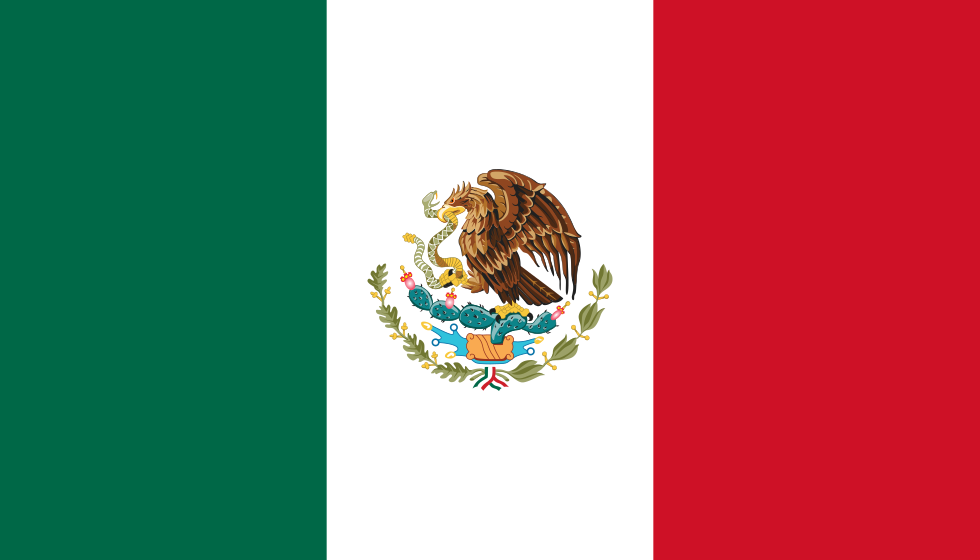
The entire world of opera was stunned when, in 1949 -- while singing Brünnhilde in Die Walküre at Venice -- she agreed to sing Elvira in <a href="spotify:artist:6AphpMkKDU4I3Z6XaGu1UV">Bellini</a>'s I Puritani, alternating performances during the same week. That same year she traveled to Buenos Aires to sing Turandot and Norma. In 1950, she sang Aida at the Teatro alla Scala, but she did not become a regular member there until 1952. Summer of 1950 brought her to Mexico City where, in one month, she sang Norma, Aida, Tosca and Il trovatore. During these early years, Callas would sing nearly any role offered including Isolde, Leonore in La forza del destino, Constanza in <a href="spotify:artist:4NJhFmfw43RLBLjQvxDuRS">Mozart</a>'s Die Entführung aus dem Serail, and Elena in I vespri siciliani.
As she matured, Callas began to concentrate on a smaller core repertory, including <a href="spotify:artist:1SXRDJxjOty2T43t4gXAnk">Cherubini</a>'s Medea, <a href="spotify:artist:6AphpMkKDU4I3Z6XaGu1UV">Bellini</a>'s Norma, <a href="spotify:artist:0OzxPXyowUEQ532c9AmHUR">Puccini</a>'s Tosca, <a href="spotify:artist:6AphpMkKDU4I3Z6XaGu1UV">Bellini</a>'s La Sonnambula, and <a href="spotify:artist:2jCGEMSZXMSOImpD8sqo56">Donizetti</a>'s Anna Bolena. Most of her other roles were heard only in one series of performances. After 1959, she rarely appeared on the opera stage, but she did sing concerts in America and Europe. Her last opera performances were in June 1965, in Paris as Norma. She came out of retirement in 1973 to tour the world with <a href="spotify:artist:6kjCrVbejP0Aw6otiMaxNt">Giuseppe di Stefano</a> in a series of recitals. Although financially rewarding, the tour did nothing to enhance her reputation. In 1971, she gave a series of masterclasses at the Juilliard School of Music in New York which were quite successful. In 1977, she died of a sudden heart attack in her Paris apartment.
Maria Callas was one of the most controversial singers of the twentieth century. She had a wide range from high E to the F below the staff, and an innate feel for the style of bel canto roles, but she was most notable for bringing a commitment and intensity to her dramatic portrayals that was nearly unprecedented at the time.
Using photorealistic video projection, Callas was brought back to the stage for a new tour in 2018. Callas in Concert features an interactive Callas on stage performing some of her most iconic recordings with a live orchestra.
Monthly Listeners
699,112
Monthly Listeners History
Track the evolution of monthly listeners over the last 28 days.
Followers
393,503
Followers History
Track the evolution of followers over the last 28 days.
Total Streams
1.2 billion
Total Streams History
Track the evolution of total streams over the last 28 days. This data is calculated from all tracks listed in the artist's discography.
Top Cities


Related Artists









Popular Tracks
5321 tracks
Bizet: Carmen, Act 1: Habanera. "L'amour est un oiseau rebelle" (Carmen, Chœur)
Aug 22, 2014
35.8 million
streams

Carmen, WD 31, Act I: Quand je vous aimerai?...L'amour est un oiseau rebelle
Jan 1, 1994
35.8 million
streams